- The problem
- A licensed security company — fire alarms, access control, video surveillance, intrusion detection, and 24/7 monitoring — needed a professional web presence equal to the trust its clients place in it. In this trade the website earns exactly one thing: the call. Buyers check licensing, service area, and a number they can tap before anything else, and a firm missing any of the three is cut before the first conversation.
- The decisive intervention
- Design and build, on the studio’s owned stack, after the client moved off a page-builder: nine pages — one for each of the five services — with the company’s state licenses displayed, click-to-call throughout, and a quote form that emails every inquiry straight to the owner with a reference ID. Scope fixed to the three things a buyer of security services must find fast: what is covered, why this firm, and how to request service.
- The shipped artifact
- The rebuilt company website — services, about, and contact path — shown as a preview on the studio’s own stack while the client’s approval and domain switch-over are pending.
- The observable result
- Rebuild complete and in client review — the preview runs on the studio’s owned stack today; it moves to the company’s own domain on the client’s go.
Work
Proof, not promises.
Every case below follows the same anatomy: the problem, the decisive intervention, the shipped artifact, and the observable result. Three kinds of evidence, kept visibly separate — real client work, the platforms this studio operates itself, and demos, always badged as demos. No invented outcomes. No borrowed logos.
01
Client work
Real engagements, described by scope. The work is ours to show. The outcomes are the clients' to publish.
- The problem
- A general contracting firm needed a website that presents the company professionally and turns visits into project inquiries. A contractor’s site is a qualification gate: clients shortlist two or three firms online, and the ones that look unprepared — or answer slowly — are cut before price is ever discussed.
- The decisive intervention
- Design and build — company presentation structured around the inquiry: services stated plainly, the firm introduced credibly, and one clear contact path for new projects. The plumbing got the same attention as the presentation: the inquiry forms — general, commercial, and bid requests — carry a reference ID on every submission, and delivery was audited and re-pointed so each one lands with the firm’s own designated contact. No intermediary inbox, including ours.
- The shipped artifact
- The company website — services, presentation, and inquiry path — live at sbpropertiesllc.com.
- The observable result
- Live and public — new-project inquiries now have a professional front door.
- The problem
- A Medicare agency needed a clear, trustworthy website where clients can understand what the agency does and reach the agent in one step. Most Medicare shoppers now research online first — and a local agent’s website is where they verify the agent is real, licensed, and reachable before they ever pick up the phone. Confusion is the default in Medicare; the site had to be the opposite.
- The decisive intervention
- Design and build — services explained in plain language, written for an audience that values clarity over flash; contact kept one step from every page.
- The shipped artifact
- The agency website — services, about, and contact — in the agency’s own voice.
- The observable result
- Live — clients can understand the offer and reach the agent directly.
02
Built & operated by the studio
Our own house platforms — the reason client work here starts from proven templates. We don't just ship these; we run them, with real users, every day.
- The problem
- More than 116,000 U.S. farms sell directly to consumers, and there is no shared, maintained record of who grows what, where, and when. Local food runs on fragmented information — scattered across social posts, paper lists, and memory. Growers, chefs, and neighbors had no shared system of record.
- The decisive intervention
- The studio designed and built the platform it now operates: a structured directory with governed data, garden crawls with digital passports, event registration, a product-recall scanner, chef booking, and member apps — then kept operating it, daily, as its own business.
- The shipped artifact
- The live platform at farmchefconnect.com, with member apps on web and Google Play.
- The observable result
- Operating today: a directory of 1,400+ gardens, farms, and markets across 44 states, with field-reported sightings, crawl, passport, and event data flowing through it.
- The problem
- A hospitality brand running culinary events and chef experiences needed a public site equal to the rooms it works in — and a proving ground for the studio’s patterns.
- The decisive intervention
- Design, build, and operate — the brand’s public presence, maintained by the studio, where several client patterns (event presentation, inquiry paths, editorial publishing) were proven first.
- The shipped artifact
- The public site at vkculinary.org.
- The observable result
- Live — the house hospitality brand’s home, and a standing test of every pattern before a client pays for it.
Six Rows Coffee
Coffee brand & commerce · Design · build · operate
- The problem
- A coffee brand needed product story and online ordering that a small team could run — subscriptions and shipping included.
- The decisive intervention
- Design, build, and operate — product story presented editorially, ordering through payment links, and the subscription and shipping patterns that later became studio templates.
- The shipped artifact
- The brand’s commerce presence — product pages and payment-linked ordering.
- The observable result
- Live — orders and subscriptions run on the patterns the studio now sells as templates.
03
Studio demos
Working demonstrations of the patterns we sell — fictional businesses and sample data, labeled as demos, never dressed as client work. Beside the demos stands Farm2Chef — not a demo and not client work: the studio's own product, built here, operated daily, and live on Google Play.
Live demo — The Gilded Hour Demo · fictional business
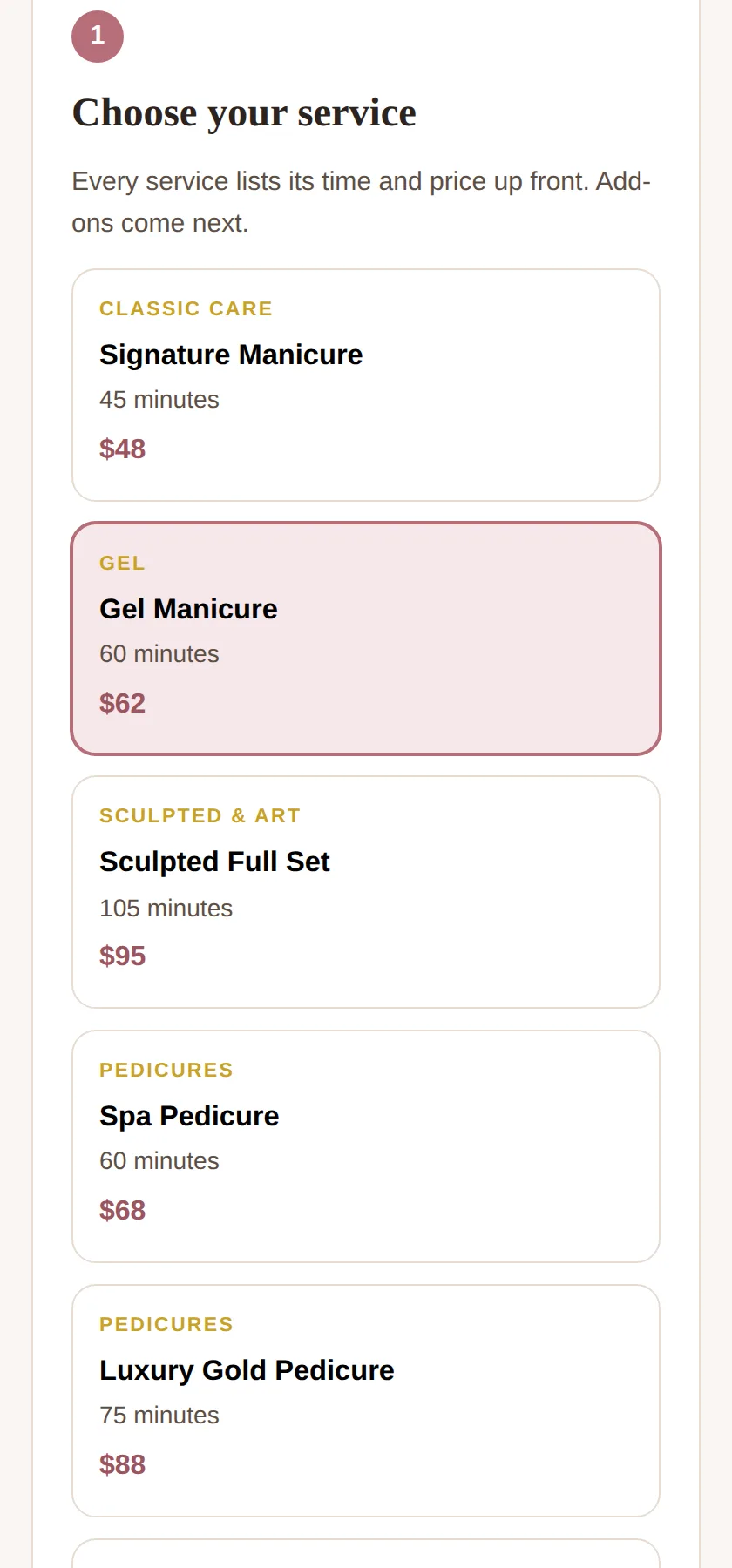
The customer books — gel manicure + chrome powder, with Maya.
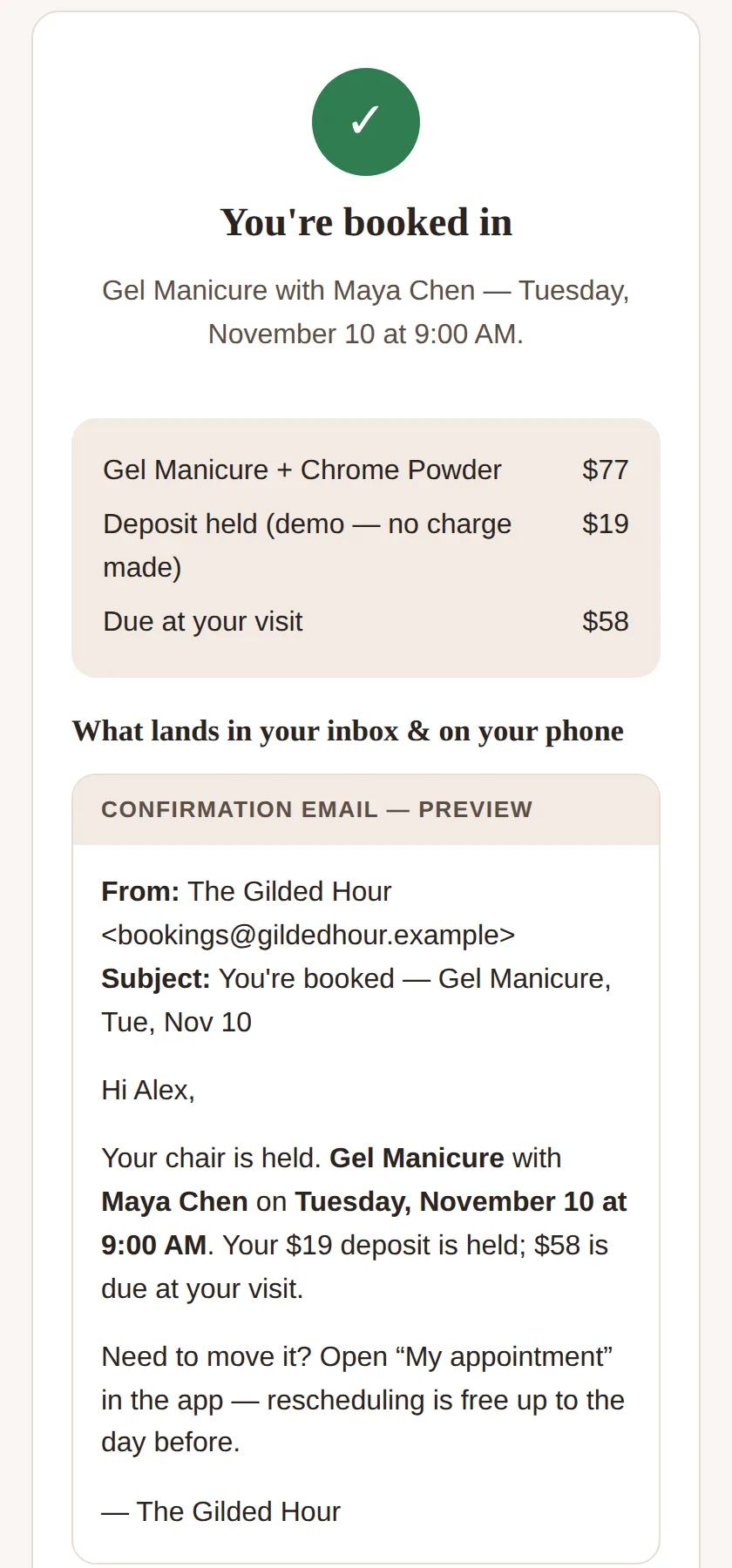
The deposit is held — $19 of $77. In the demo, never charged.
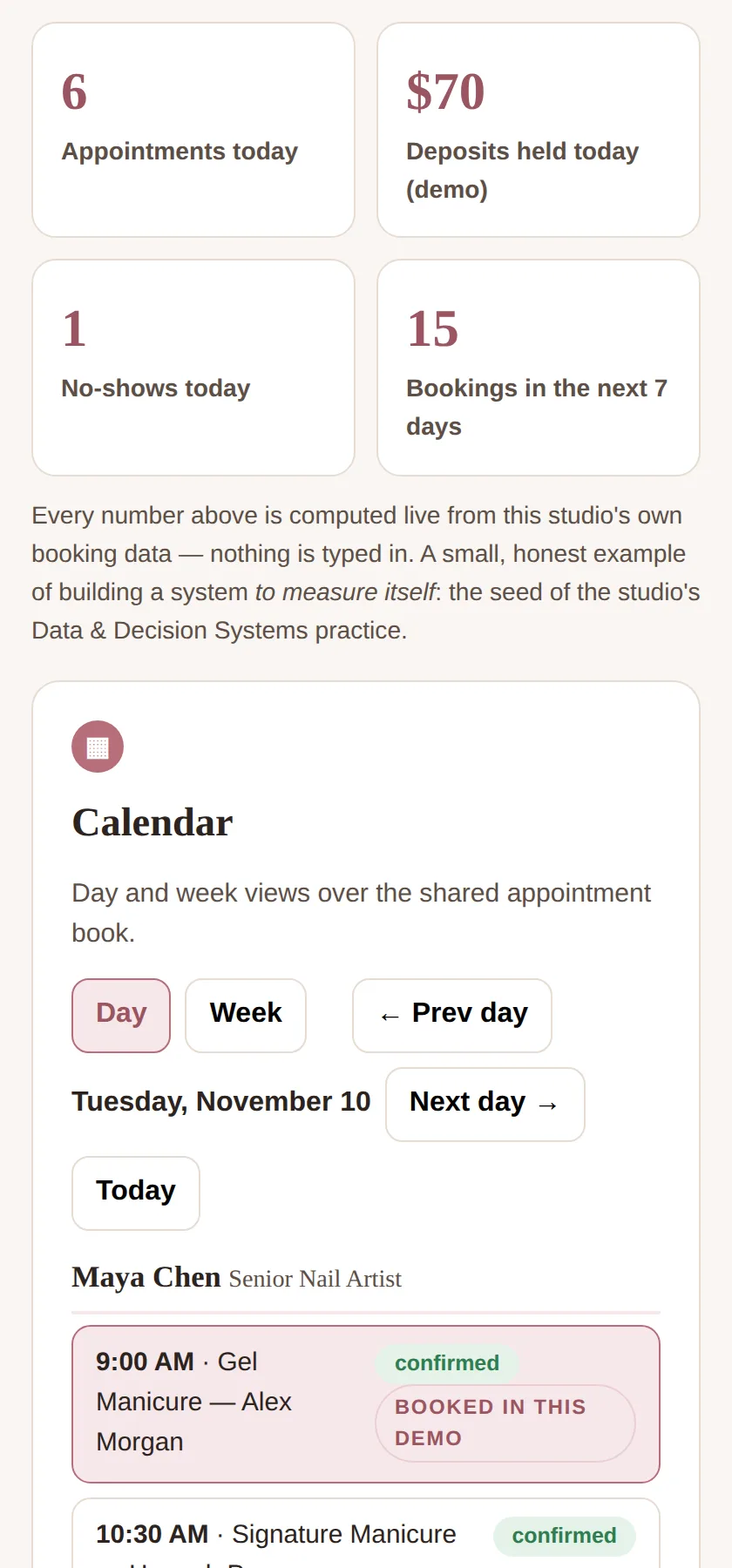
The owner sees the same book — the booking, on the calendar.
The frames are the system itself, caught mid-booking — and the live demo is one tap away. Book a chair and the booking lands on the owner's calendar; reschedule or cancel and the calendar moves with it — one book, read the same way by both sides.
Demo · Live
Salon & spa booking system
The Gilded Hour — Nail Studio & Spa (fictional). The full booking journey, end to end: service catalog → technician → live availability → deposit → confirmation and reminder previews — with the owner's calendar running on the same book.
Our own product — Farm2Chef Live · Google Play
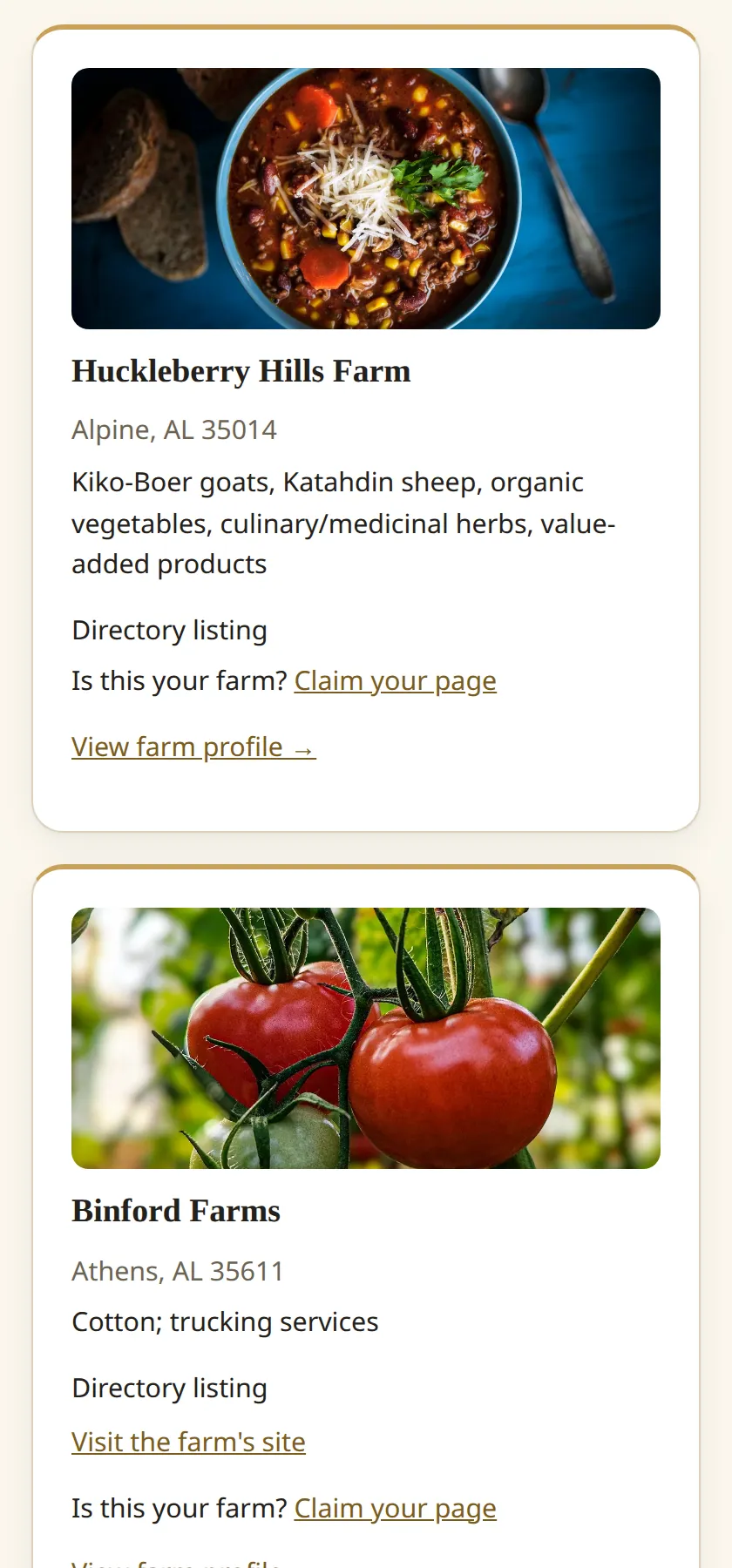
The directory, at scale — every farm with its place, its photo, and what it grows.
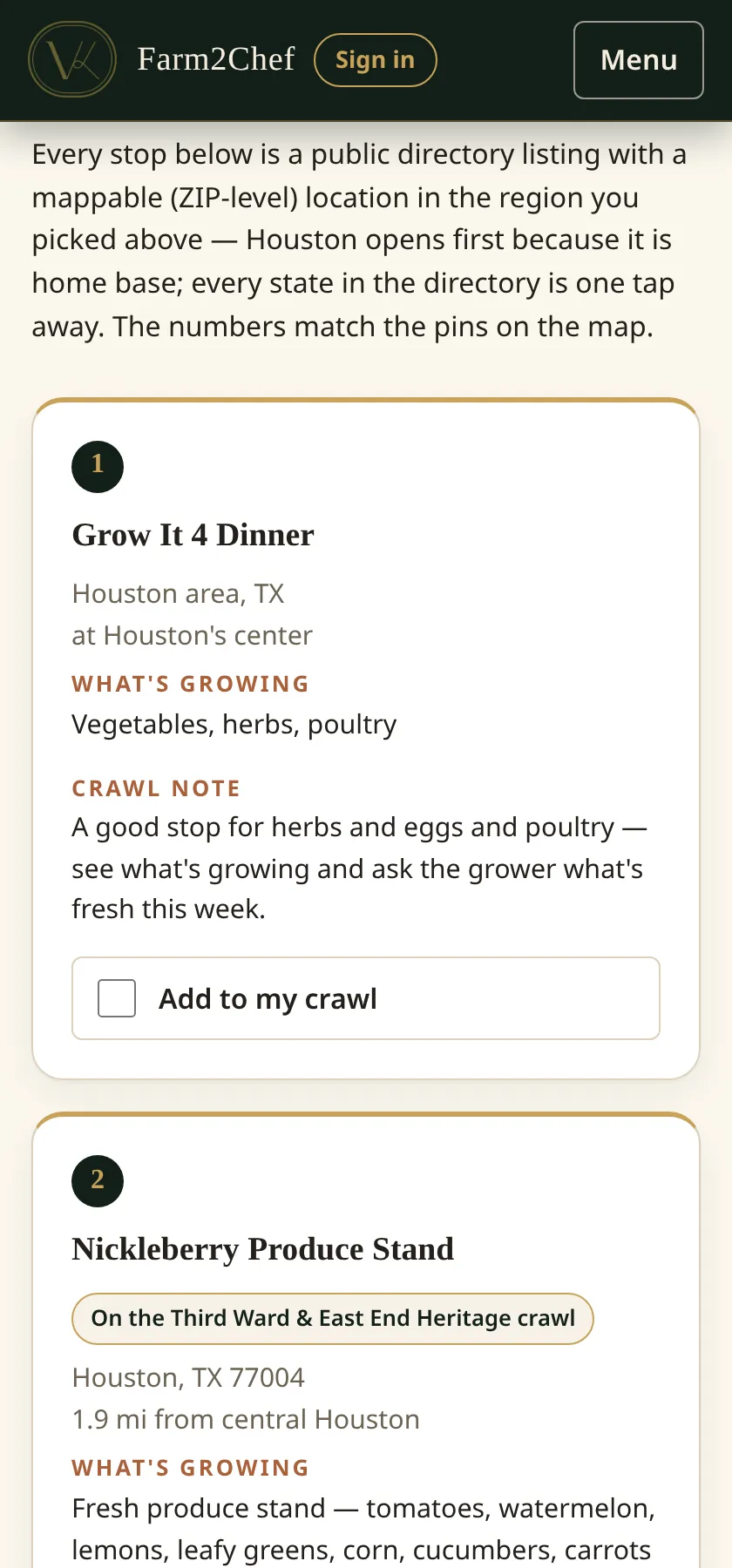
Garden crawls — numbered stops, crawl notes, what’s growing this week.
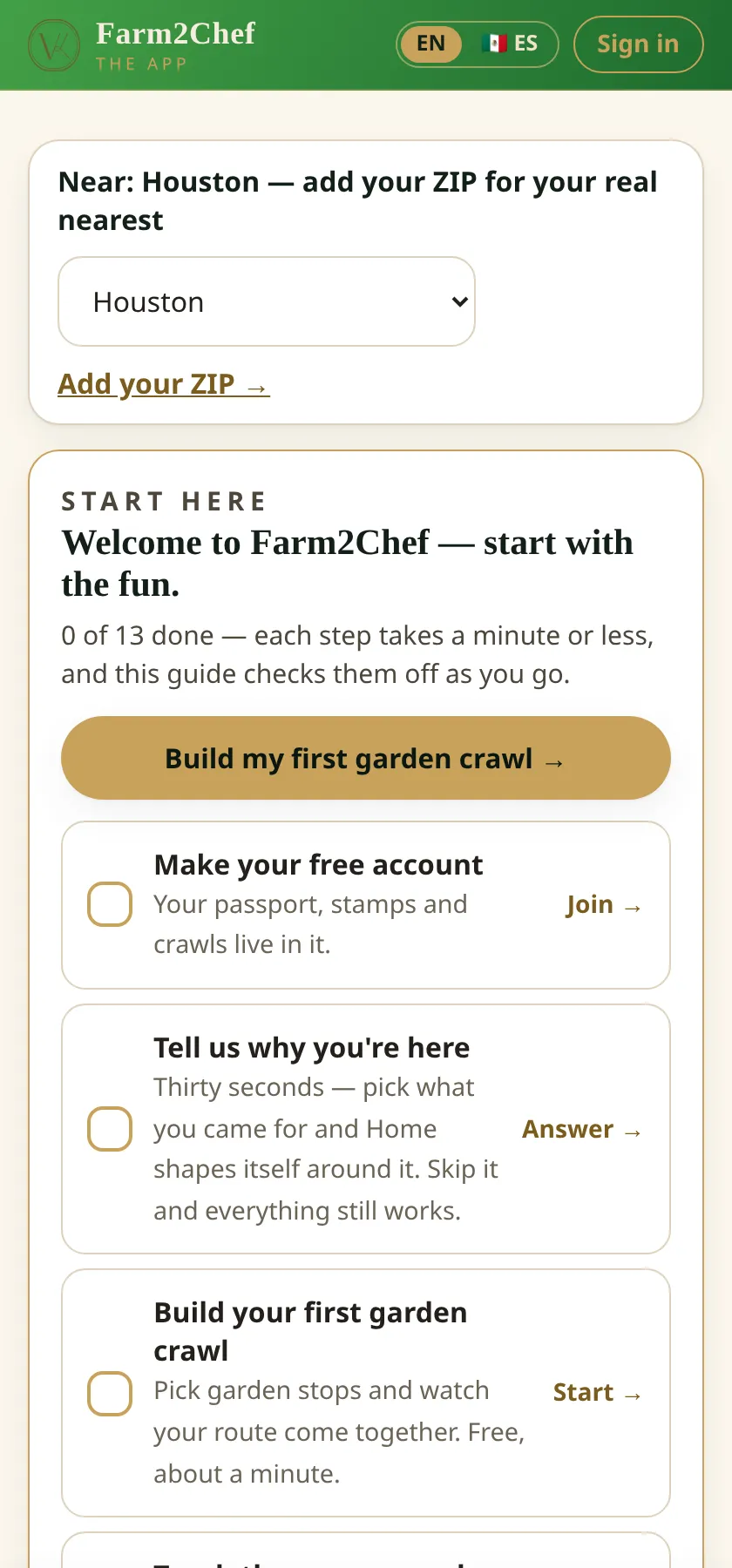
The app home — start here, build a crawl, carry the passport.
The frames are the real app — the same build members run today, caught in a fresh guest view. Not a mock-up, and not a demo: this one is ours, and it is live.
Live · Google Play
Farm2Chef — the local-food platform
The studio's own product, incubated here and operated daily: a directory of 1,400+ gardens & farms across 44 states, garden crawls with digital passports, chef booking, and a label scanner — connecting people to the growers, chefs, and markets near them.
Live demo — Bayou City Air & Plumbing Demo · fictional business
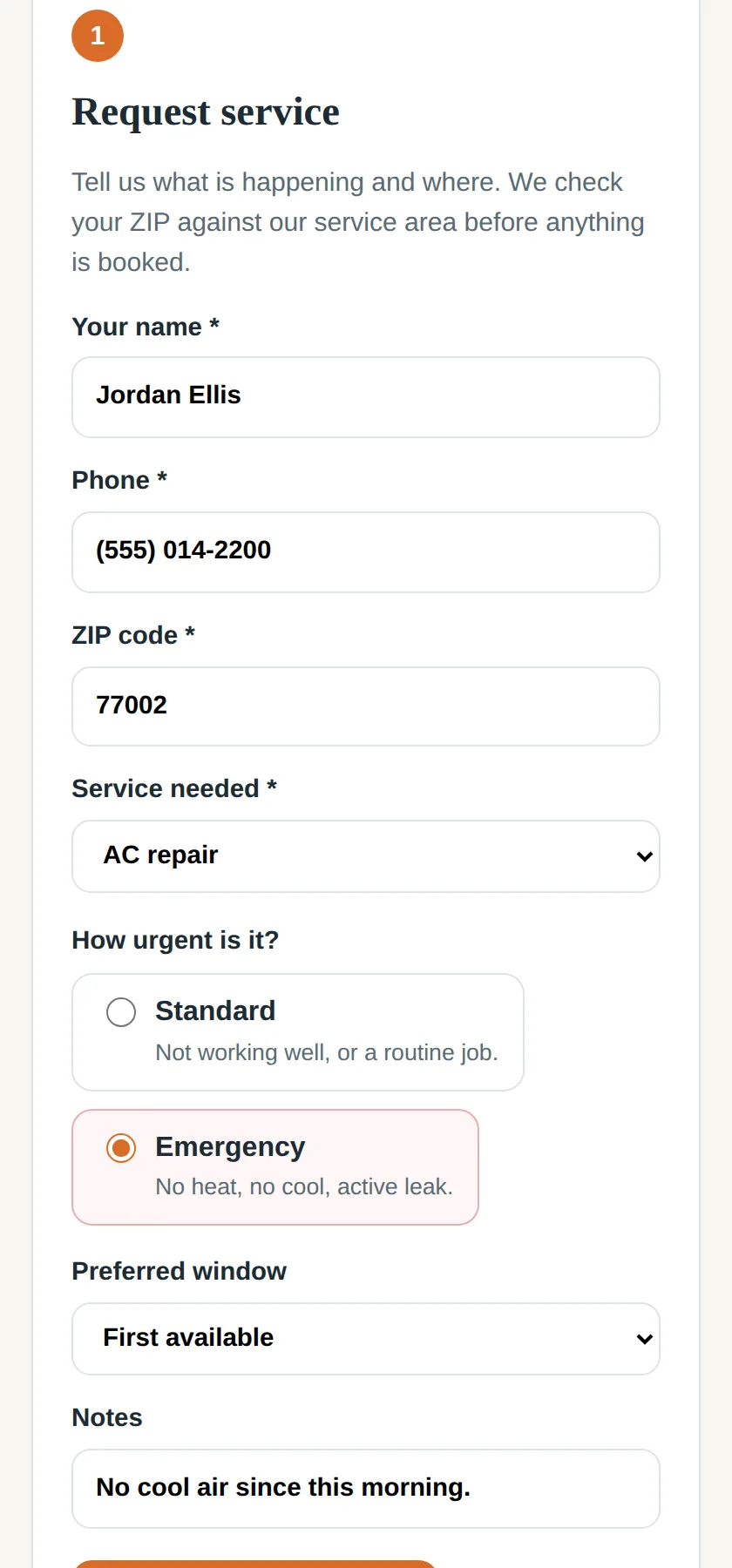
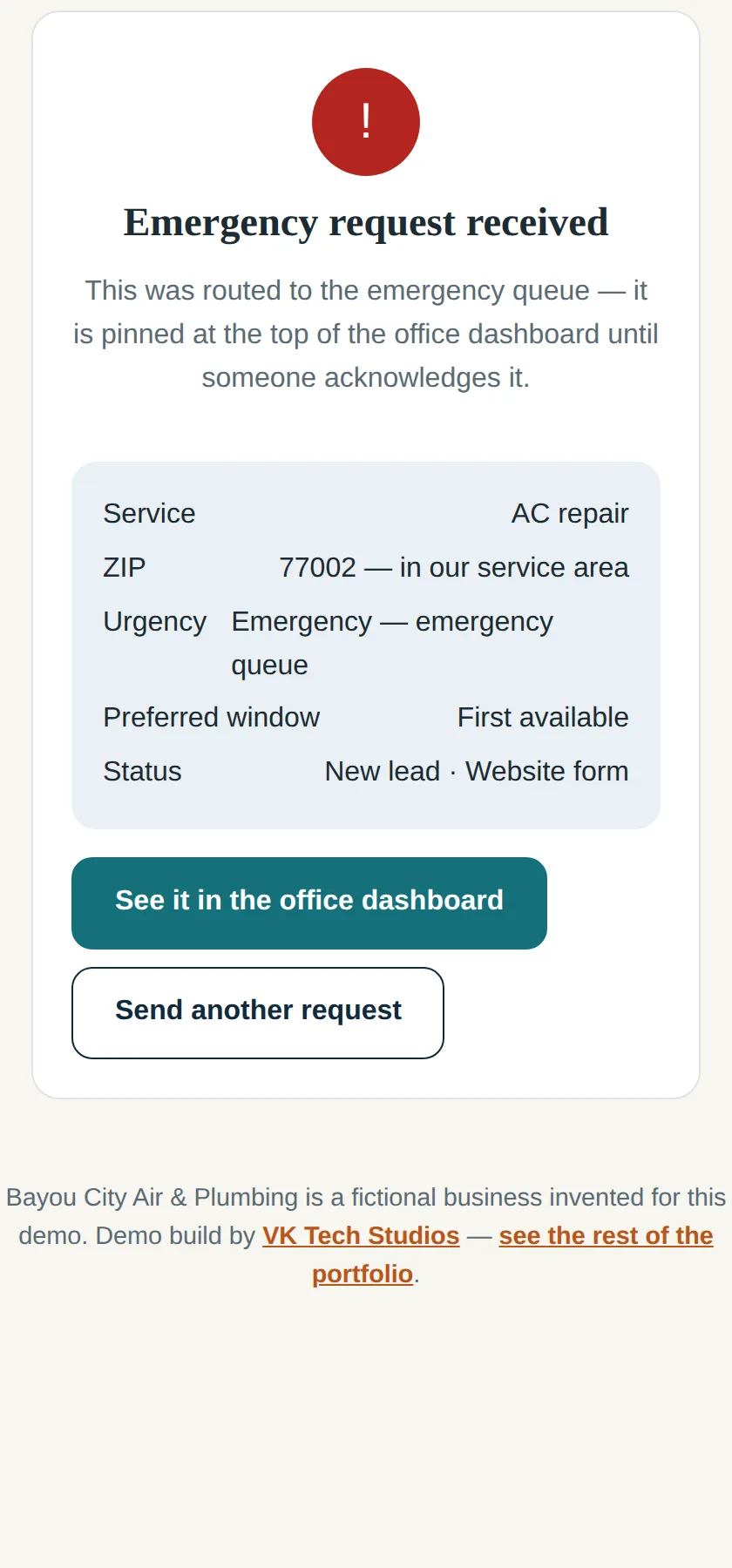
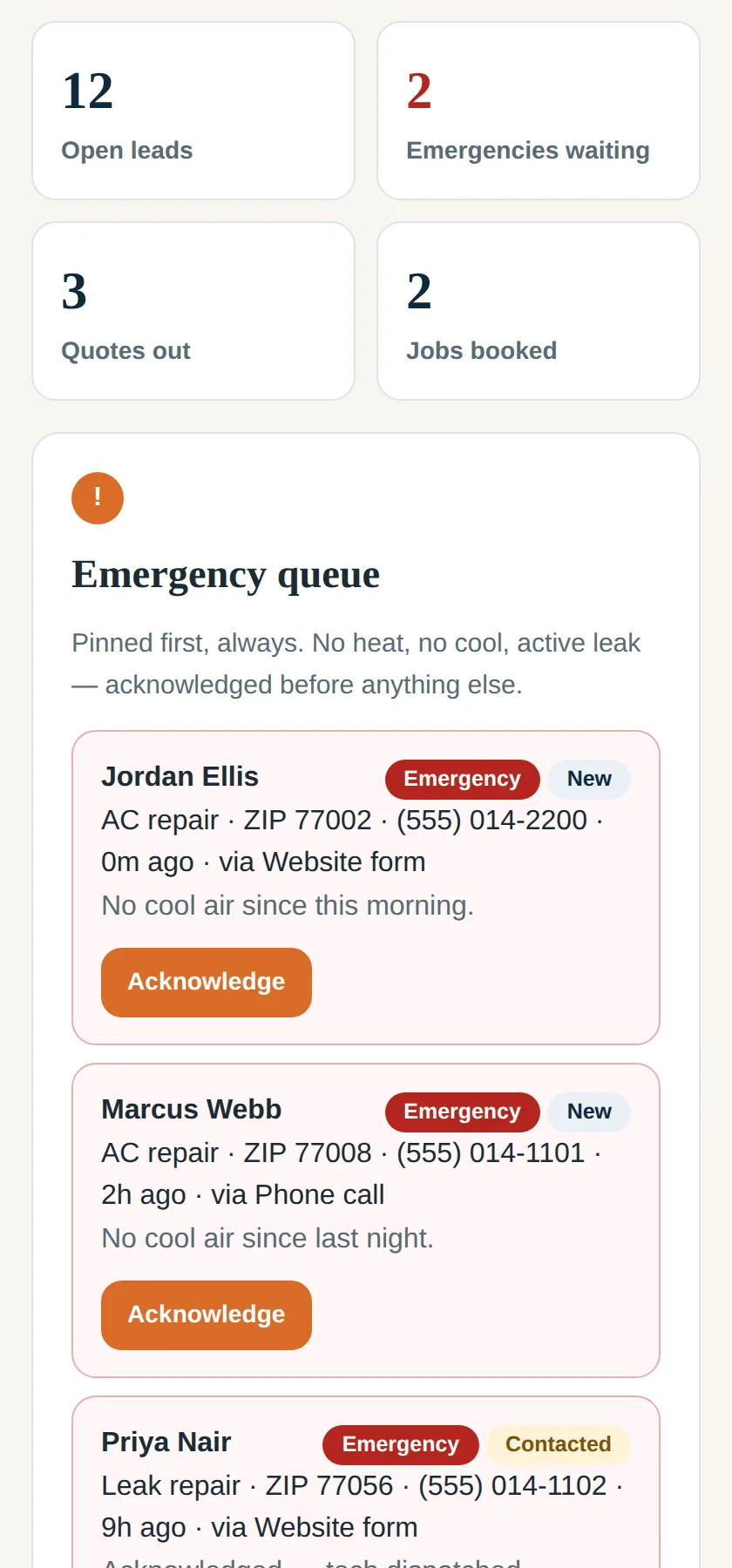
The customer asks — ZIP first, and an emergency is flagged as one.
An emergency is routed, not queued — the confirmation says exactly where it went.
The office sees it pinned — the emergency queue, with the new lead already on top.
The frames are the system itself — a request sent as a customer, landing where the office actually works it. Send one yourself and flip to the office view: it is already there, at the top of the queue.
Demo · Live
Home services lead dashboard
Bayou City Air & Plumbing (fictional). A lead-gen site with a ZIP-checked service area and emergency routing, running into the lead dashboard the office works from — pipeline stages, quotes out, jobs booked, every number computed from the same book the form writes to.
Live demo — Copperline Outdoor Supply Demo · fictional business
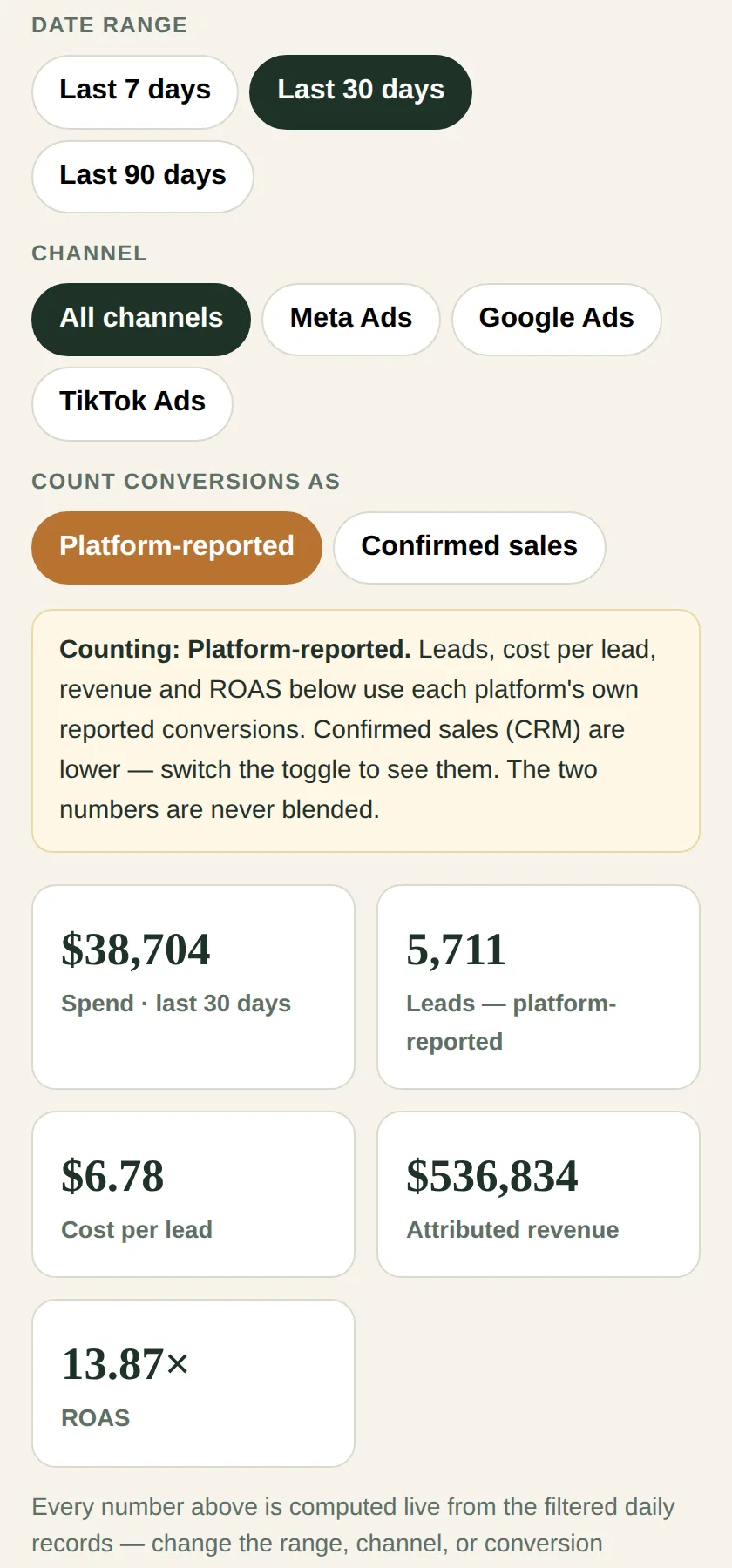
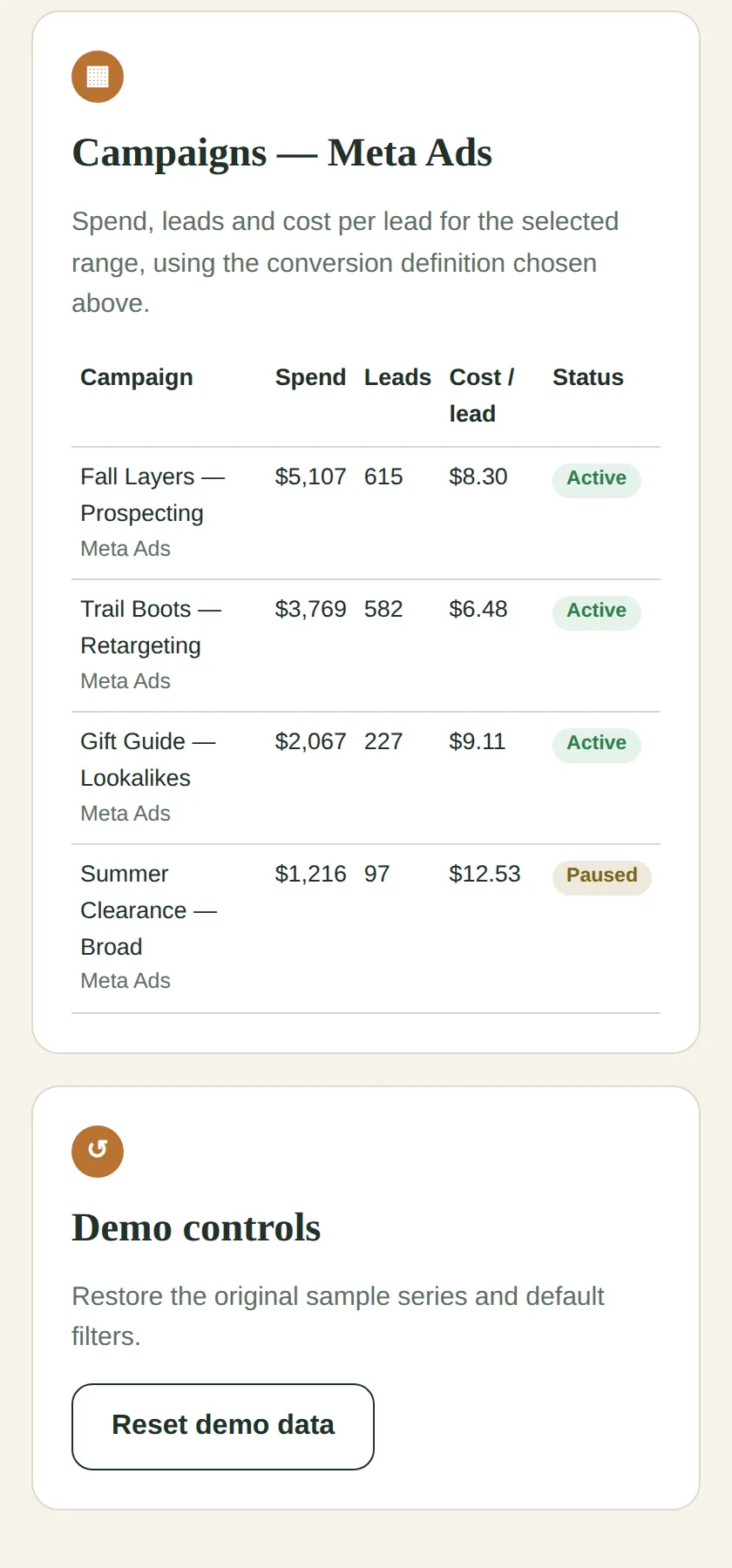
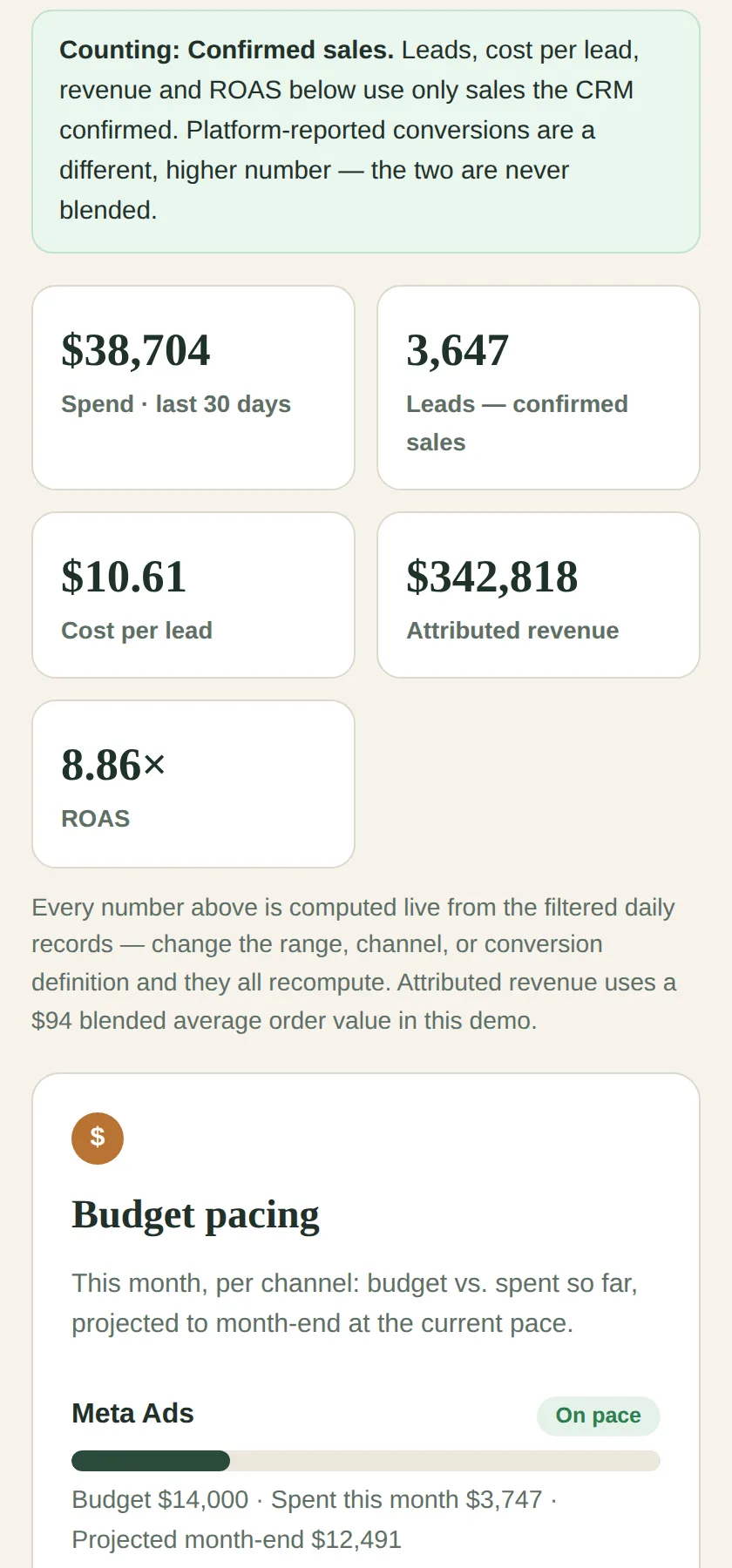
Every channel, one view — spend, leads, cost per lead, return.
Drill to the channel — its campaigns and its numbers, nothing rolled up and hidden.
Counted honestly — confirmed sales only, and one channel is pacing over budget.
The frames are the dashboard itself, mid-decision — including the third, where the counting is switched to confirmed sales and the honest numbers are smaller than the platform's. That gap is the product.
Demo · Live
Ad-spend dashboard
Copperline Outdoor Supply (fictional). Spend, leads, cost per lead, ROAS, and budget pacing across Meta, Google, and TikTok — with platform-reported conversions kept visibly separate from confirmed sales. The two numbers are never blended, and the dashboard says so on its face.
Live demo — Verdigris restaurants Demo · fictional business
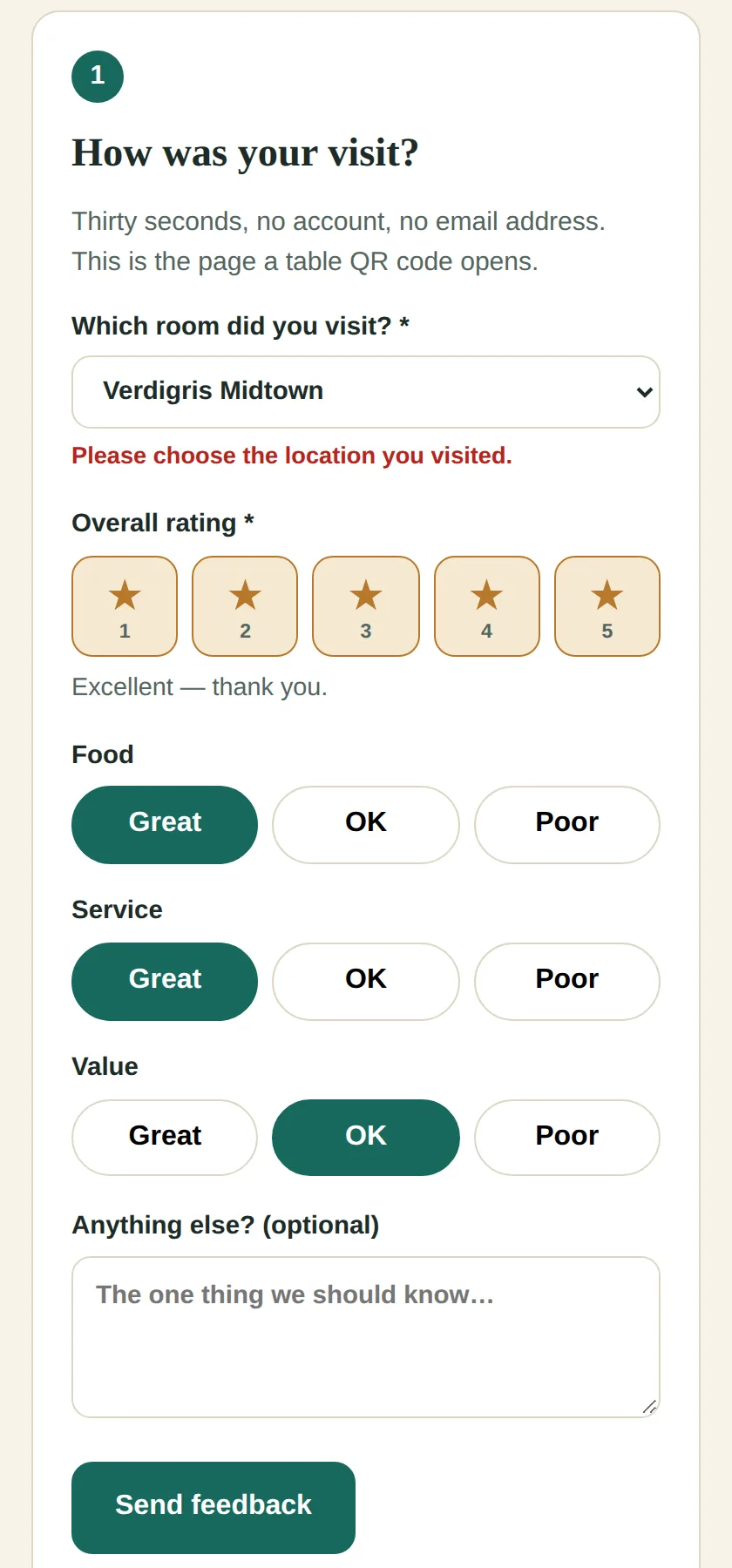
The guest answers — two minutes, five stars, three quick taps.
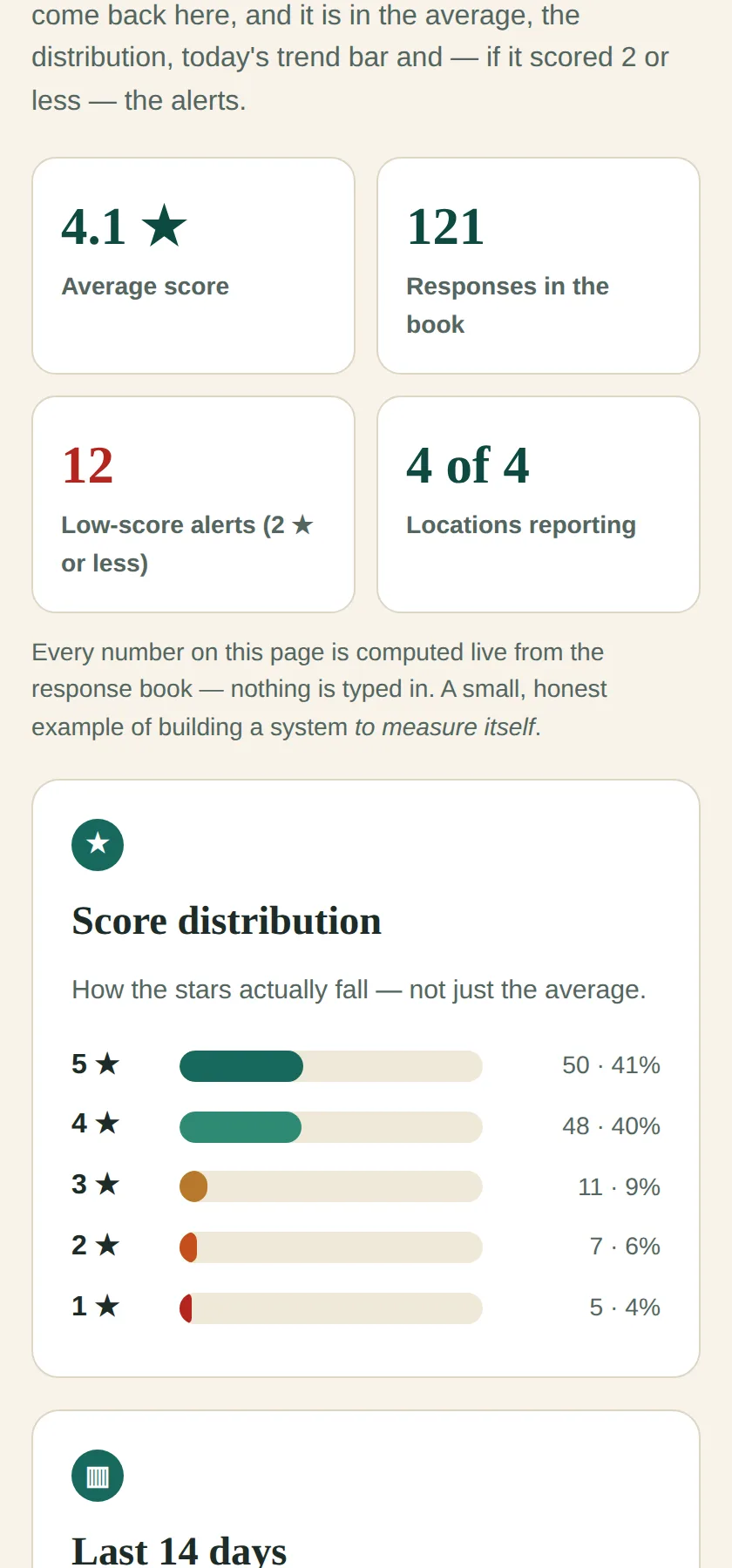
The manager sees the average with its distribution — never just the headline.
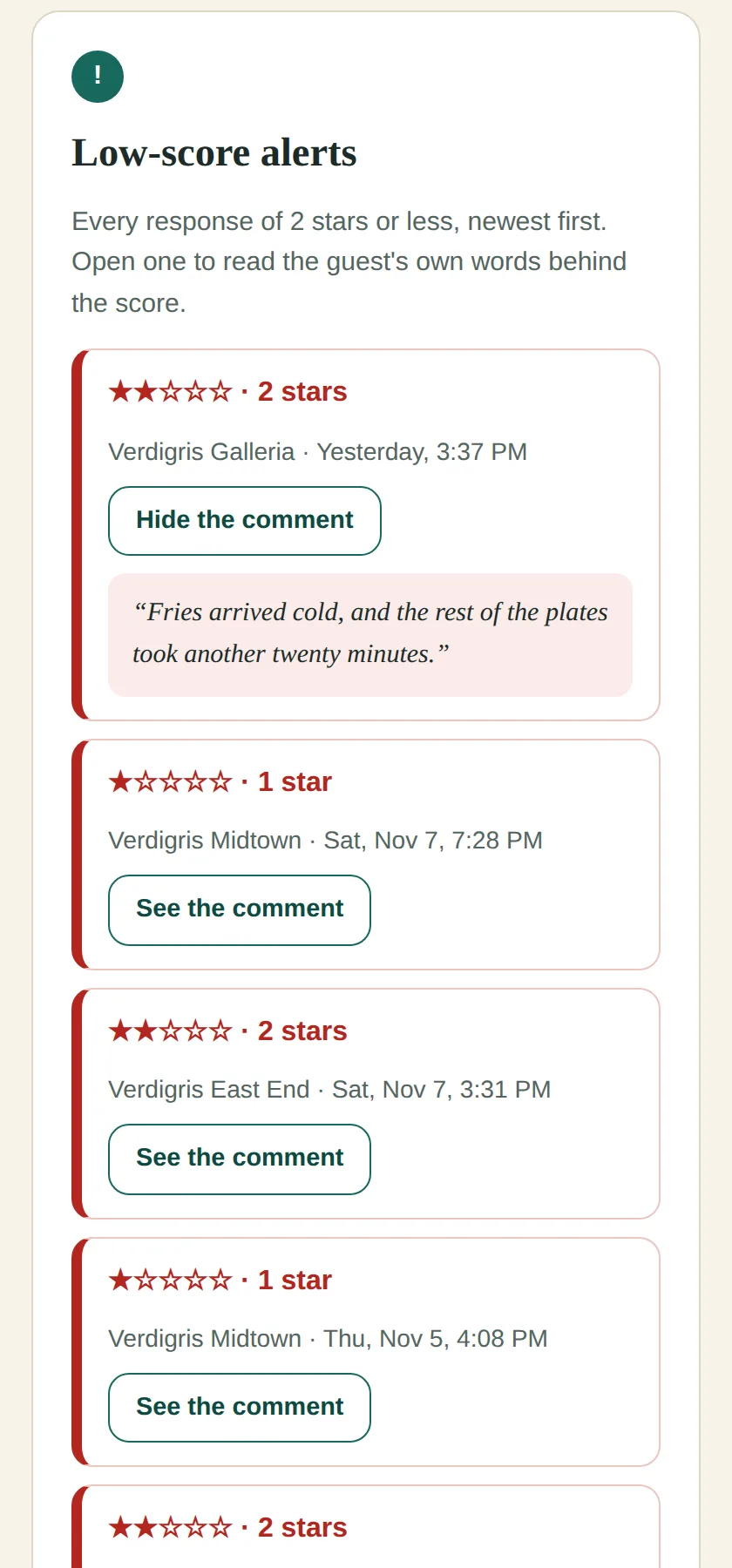
A low score drills straight to the words behind it.
The frames are the system itself, caught mid-loop — the survey a guest just answered is already inside the average, the distribution, and, when it scores low, the alerts. Answer it and watch the book move.
Demo · Live
QR survey system
Verdigris (fictional), a four-location restaurant group. A two-minute survey behind a QR code, and the dashboard behind it: the score with its full distribution, a 14-day trend, location comparison, and low-score alerts that open onto the actual comment behind the score.
Live demo — Ironroot Studio Demo · fictional business
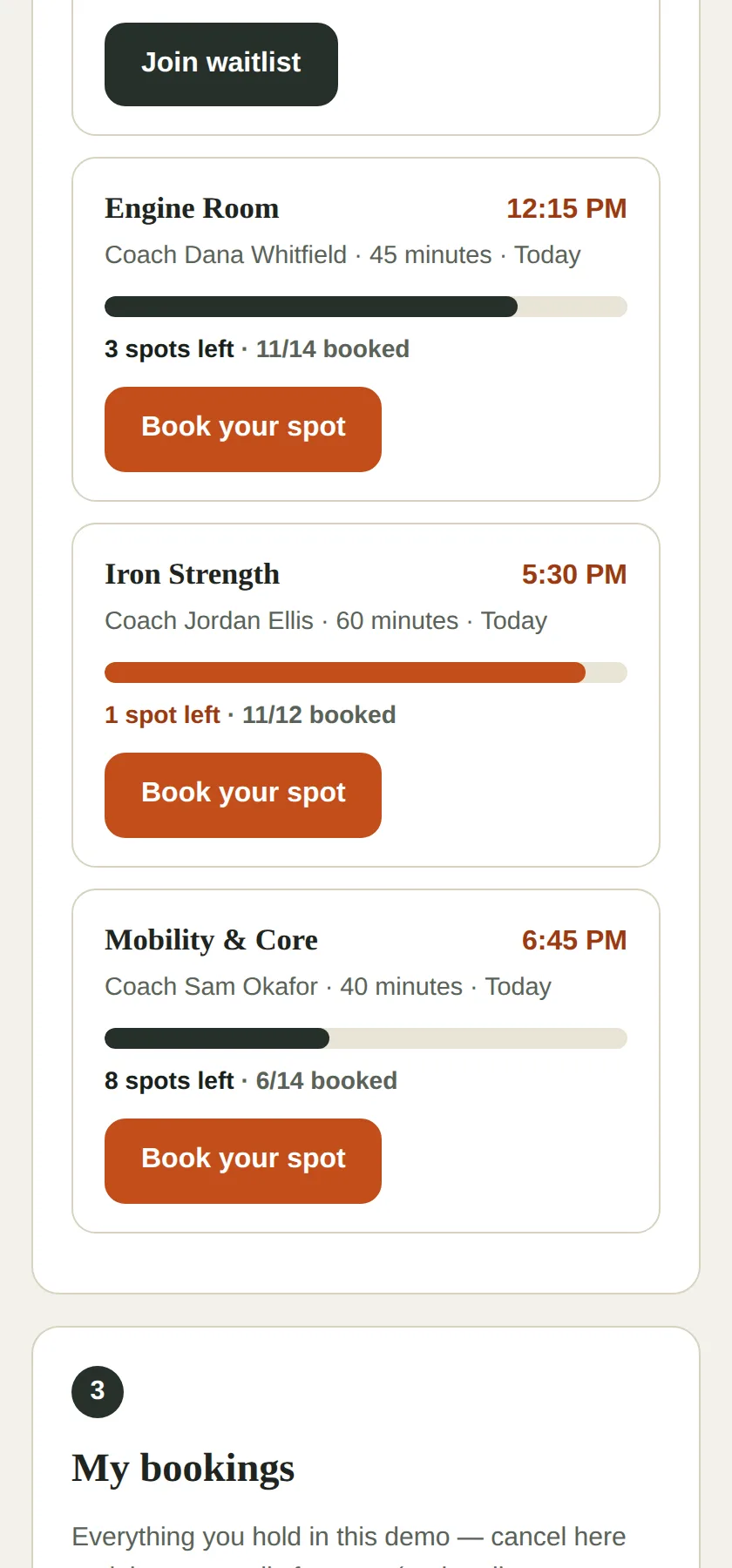
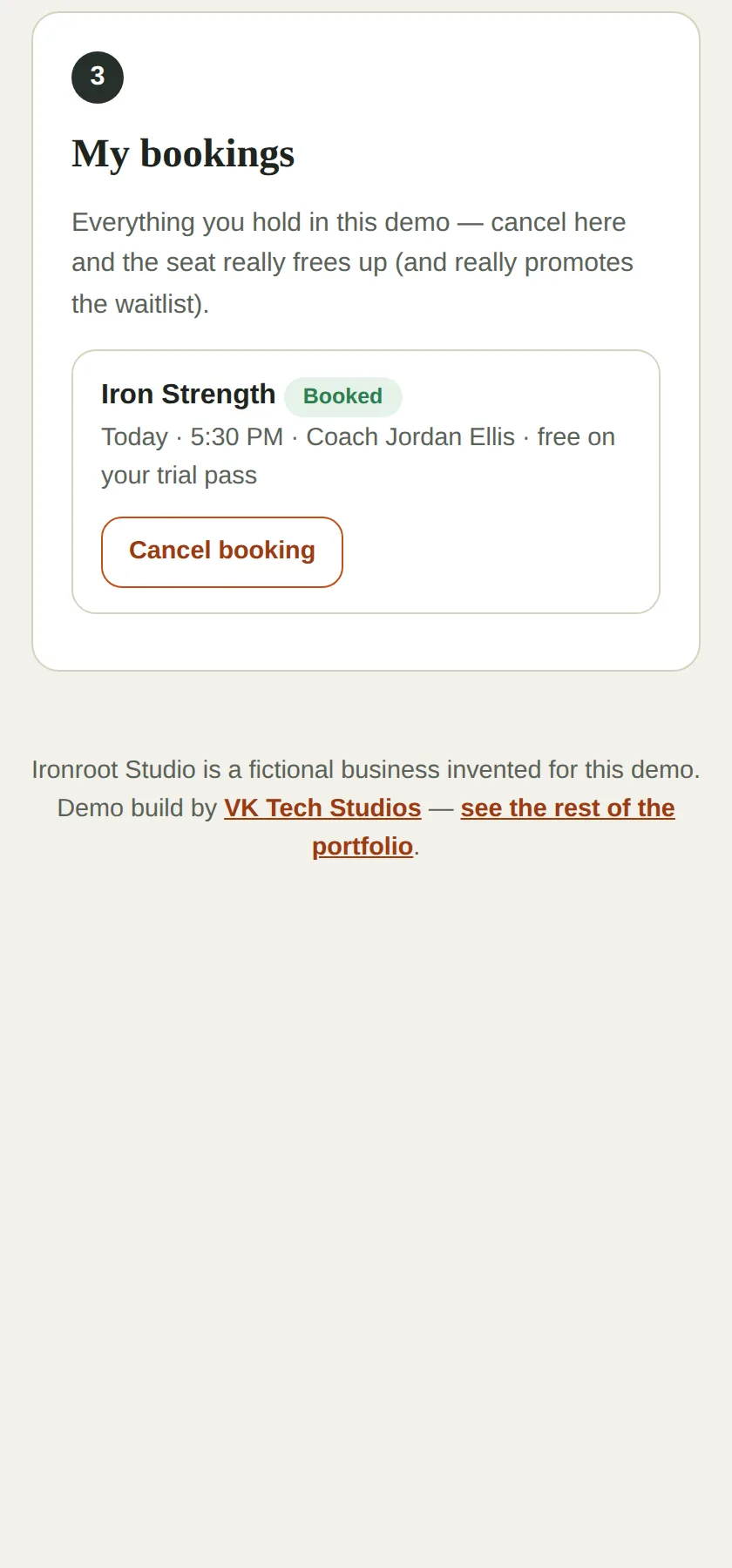
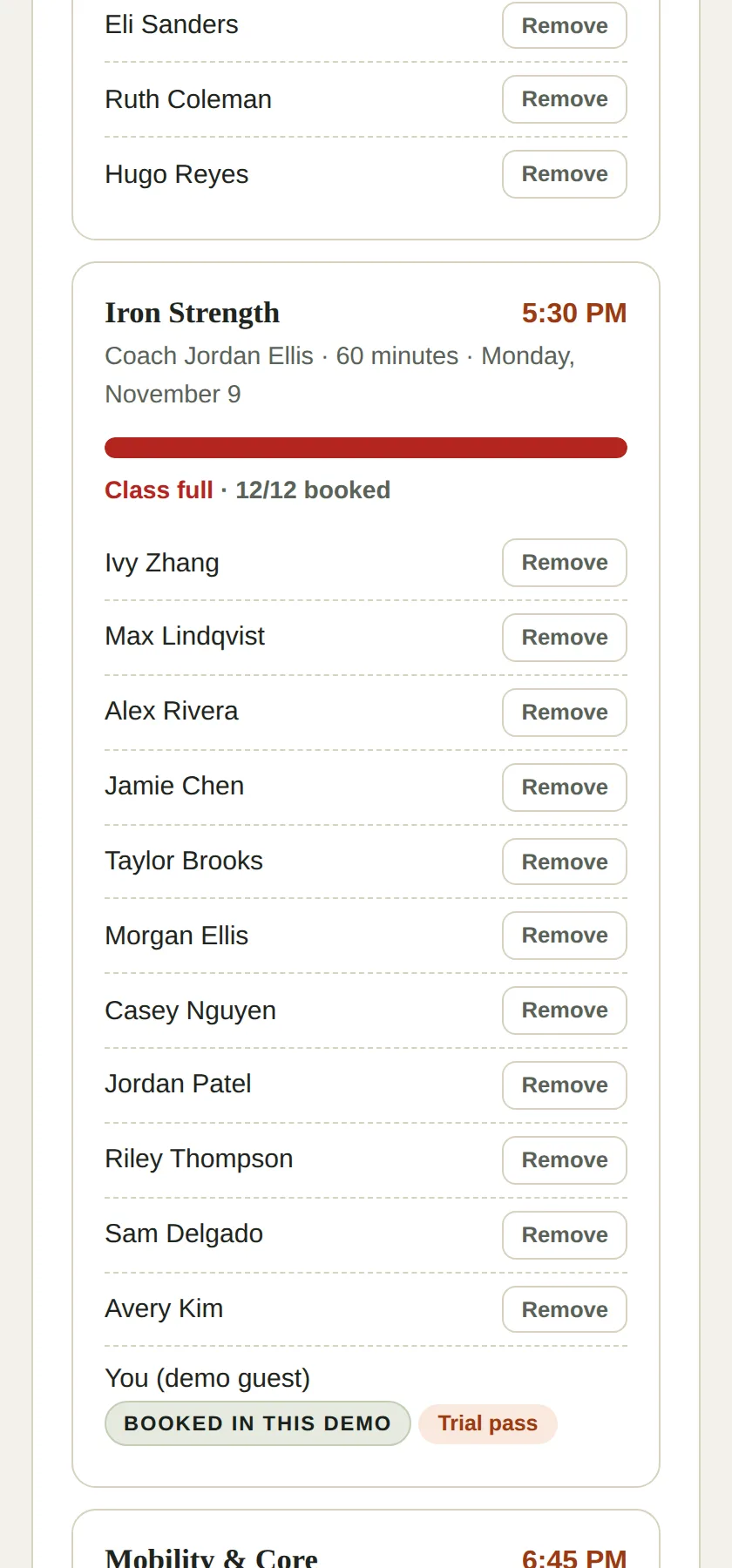
The member books — capacity is real, and a full class waitlists instead.
Booked on a trial pass — the seat is held and the book is updated.
The owner sees the same book — a full class at 12 of 12, rosters included.
The frames are the system itself — one class book, read by the member's phone and the owner's morning alike. Book the last spot and the class is full; cancel and the waitlist moves.
Demo · Live
Fitness studio system
Ironroot Studio (fictional). A class schedule with live capacity and waitlists, a trial-pass funnel, and an owner view of occupancy and trial conversion — the numbers that decide staffing, computed from the book itself.
Live demo — Clearpath Dental Studio Demo · fictional business
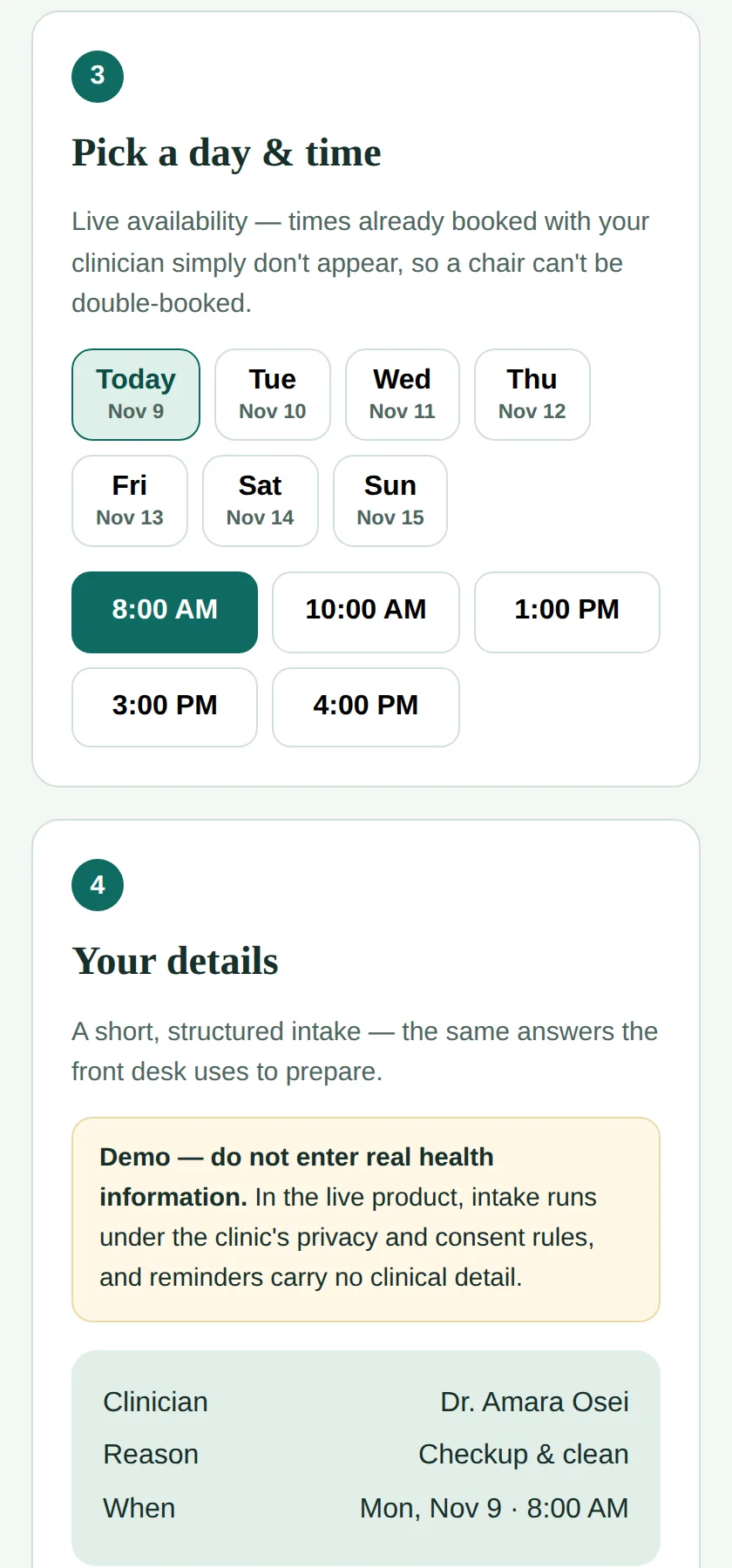
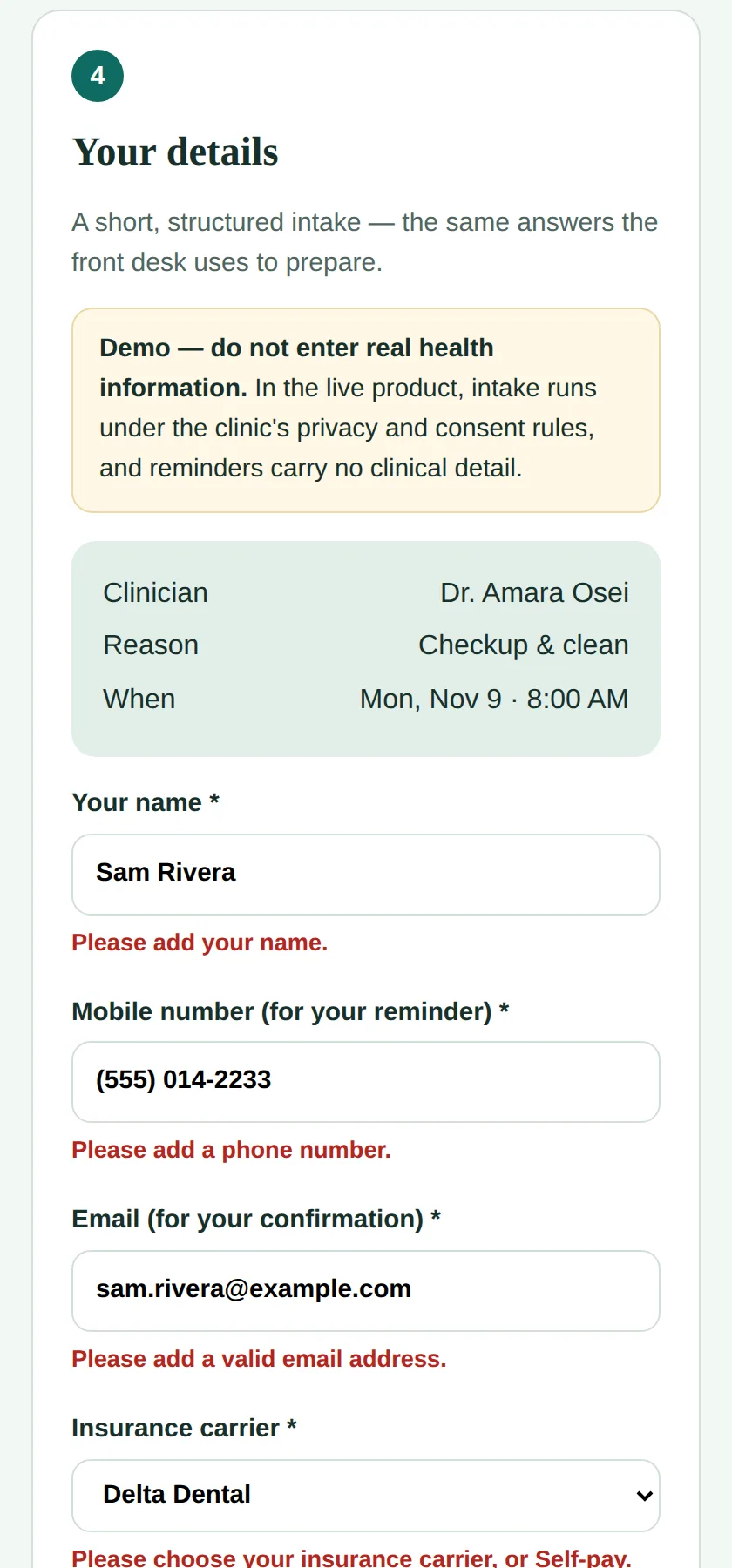
The patient books — a provider, a reason, a slot that is actually open.
Intake is structured, and the rules are printed on the page — a demo takes no real health data, ever.
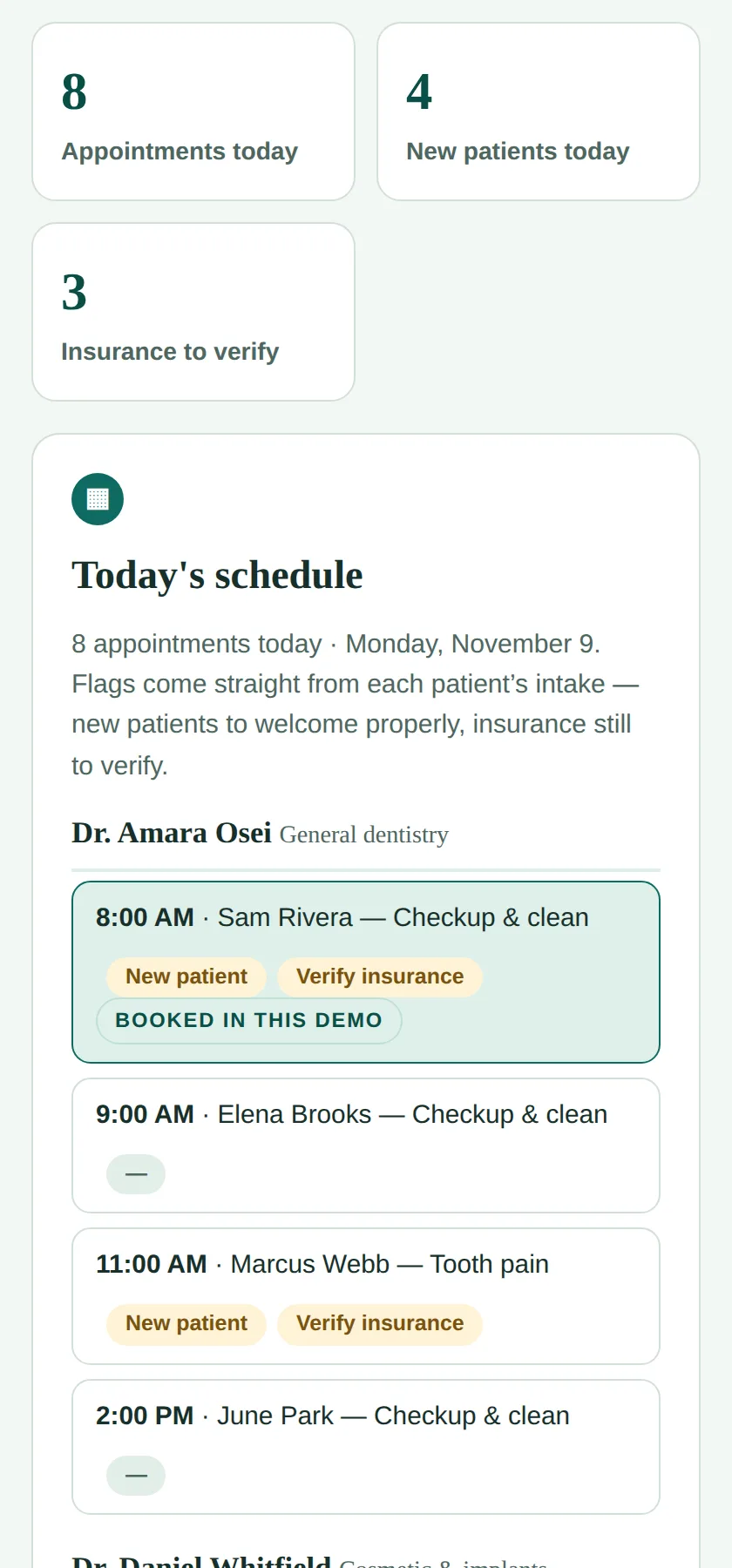
The front desk sees the day — with the new booking flagged from its own intake.
The frames are the system itself — a visit booked as a patient, sitting on the front desk's day with its intake flags already attached: new patient, insurance to verify.
Demo · Live
Clinic booking & intake
Clearpath Dental Studio (fictional). Provider booking with real availability, structured intake, and reminders that carry no clinical detail — compliance treated as a design constraint from day one, and printed on the page where patients can see it.
Live demo — Hartwell & Voss LLP Demo · fictional business
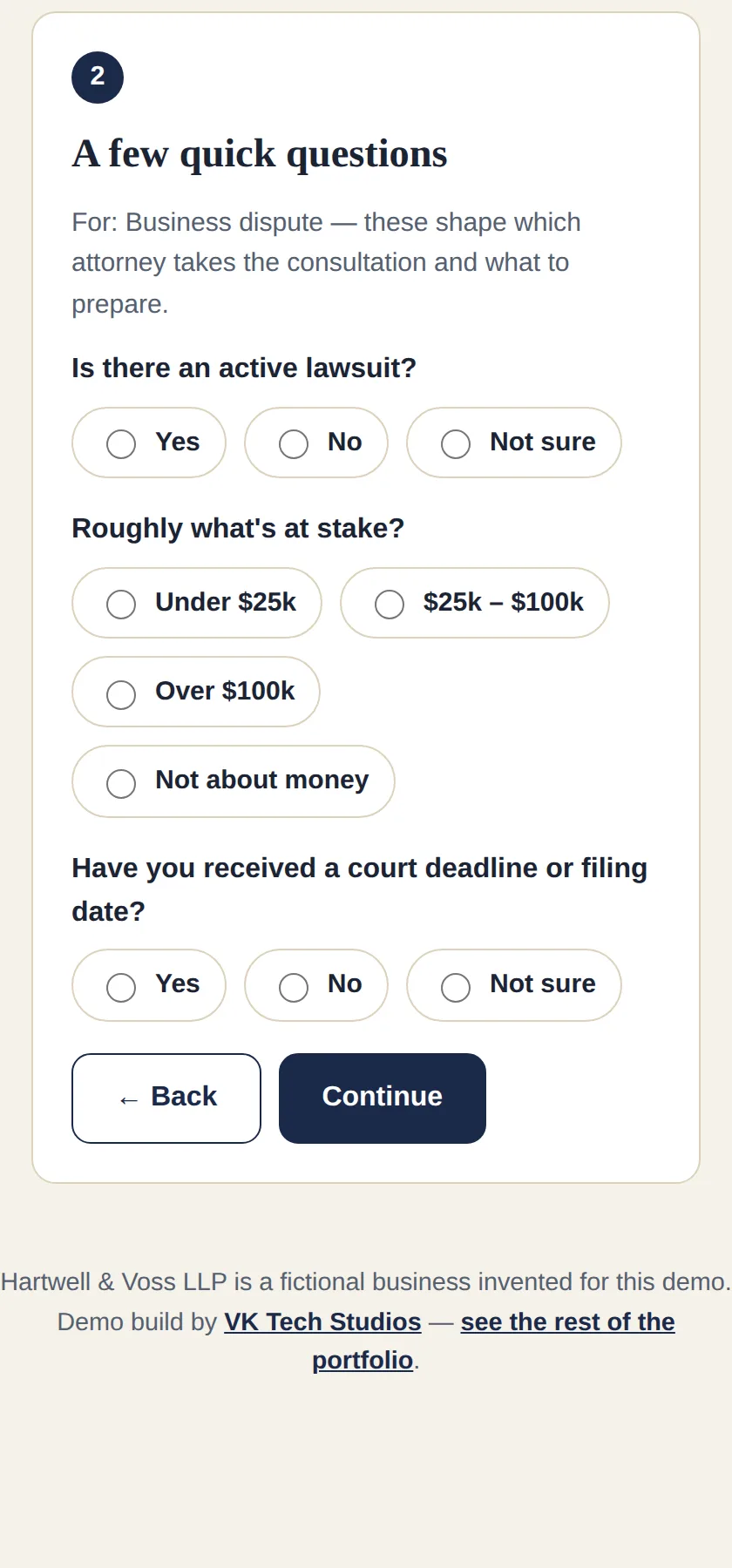
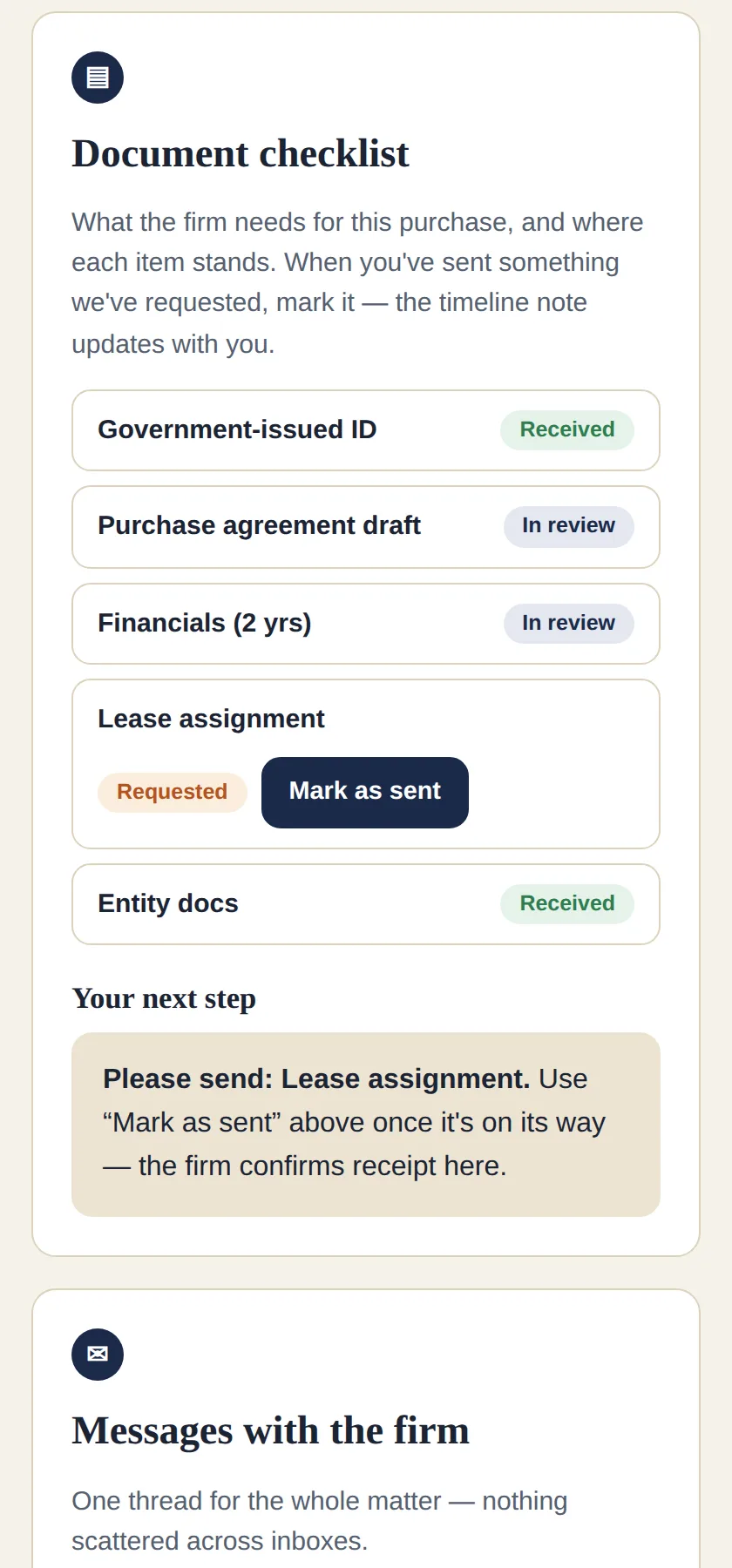
The funnel qualifies — and says no where the firm itself would say no.
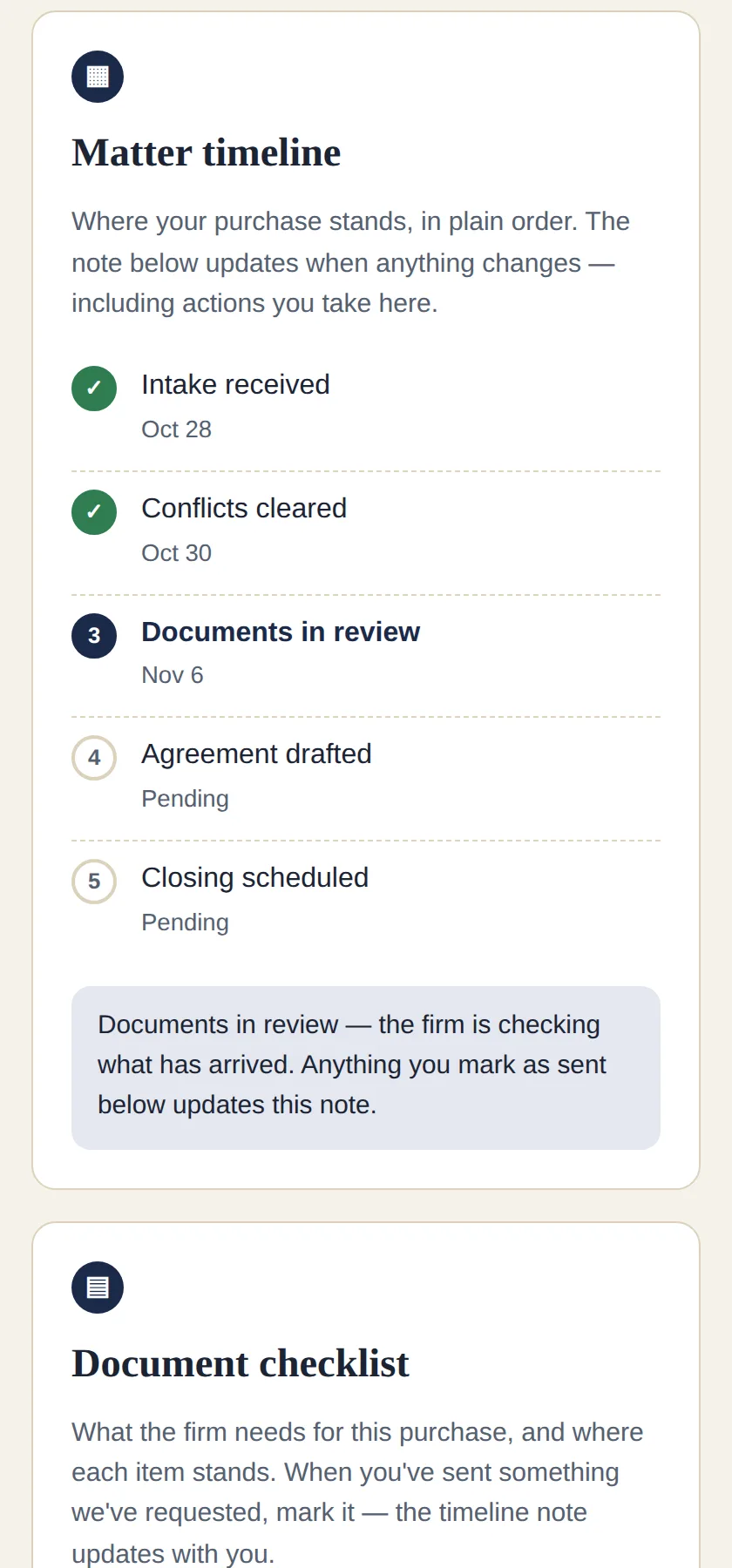
The client sees status — a timeline instead of an email asking for one.
A document marked sent moves the matter — and the next step recomputes.
The frames are the system itself — the qualifier's questions, then the same matter from the client's side of the portal, where nobody has to email anybody to learn where things stand.
Demo · Live
Legal client portal
Hartwell & Voss LLP (fictional). A consultation qualification funnel with an honest out-of-scope branch and a conflict check, and a client portal where the matter's status, documents, and next step are visible instead of chased by email.
Live demo — Three Sisters Farm Demo · fictional business
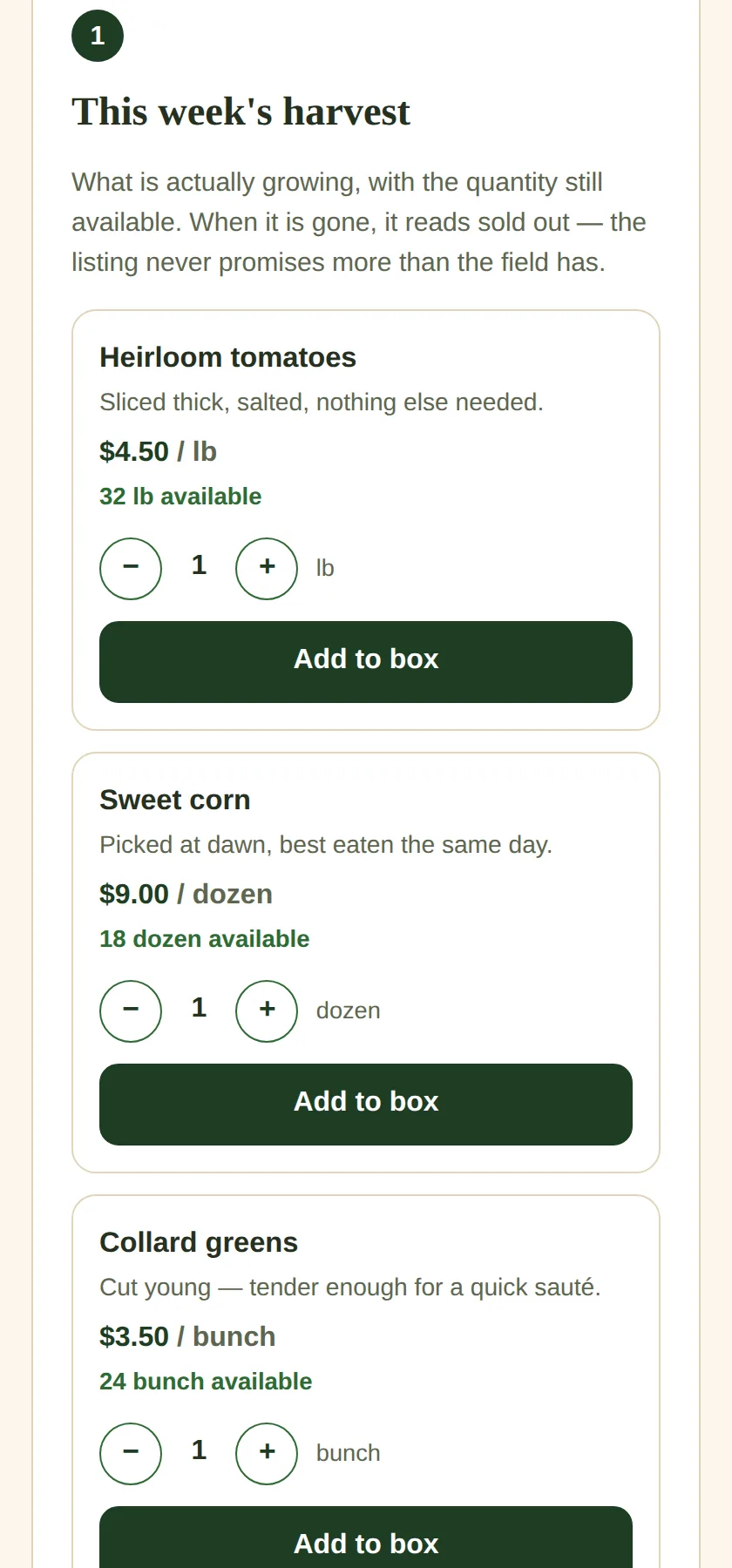
The customer shops the week — what is growing, and how much of it is left.
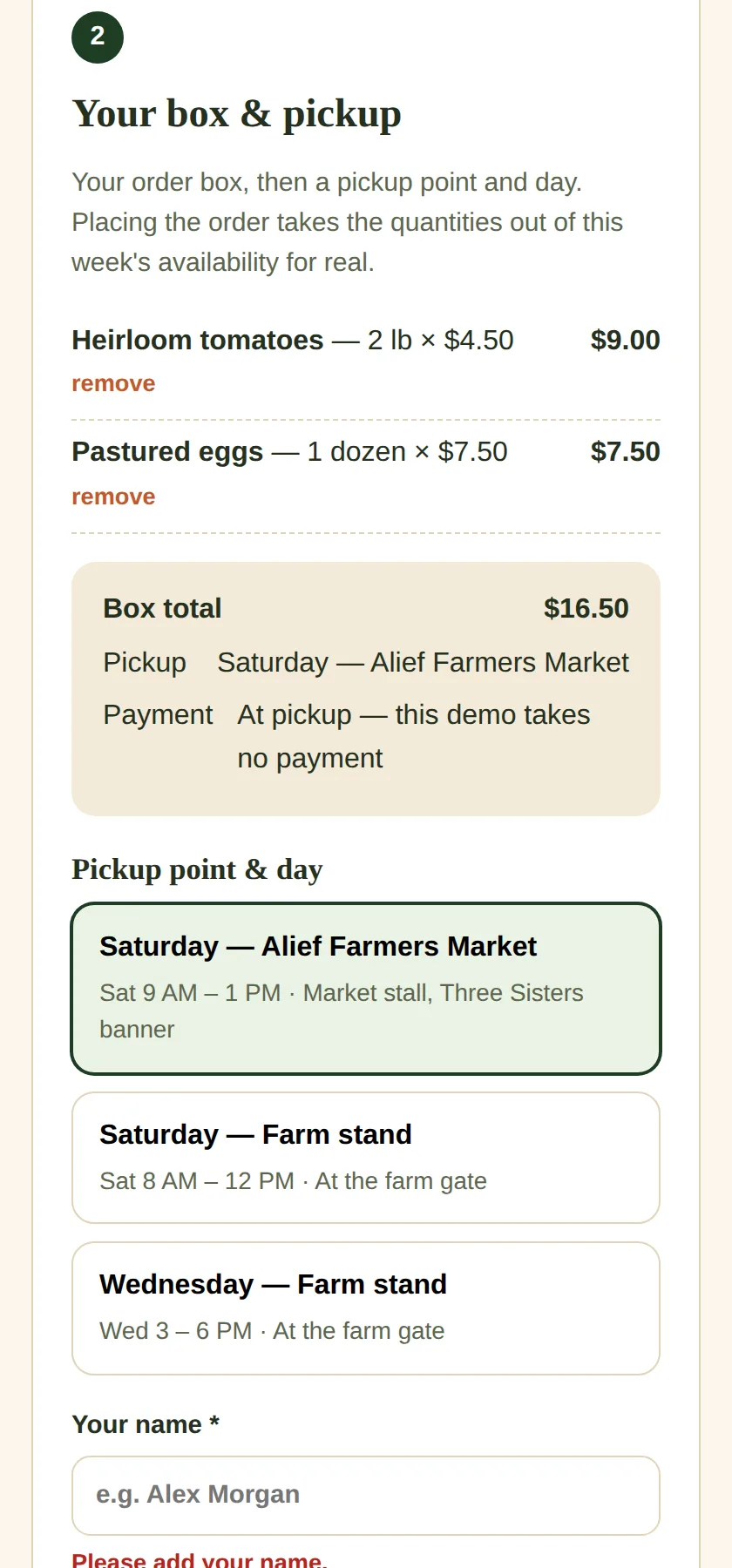
A box, a pickup slot, an order — the stock moves when the order is placed.
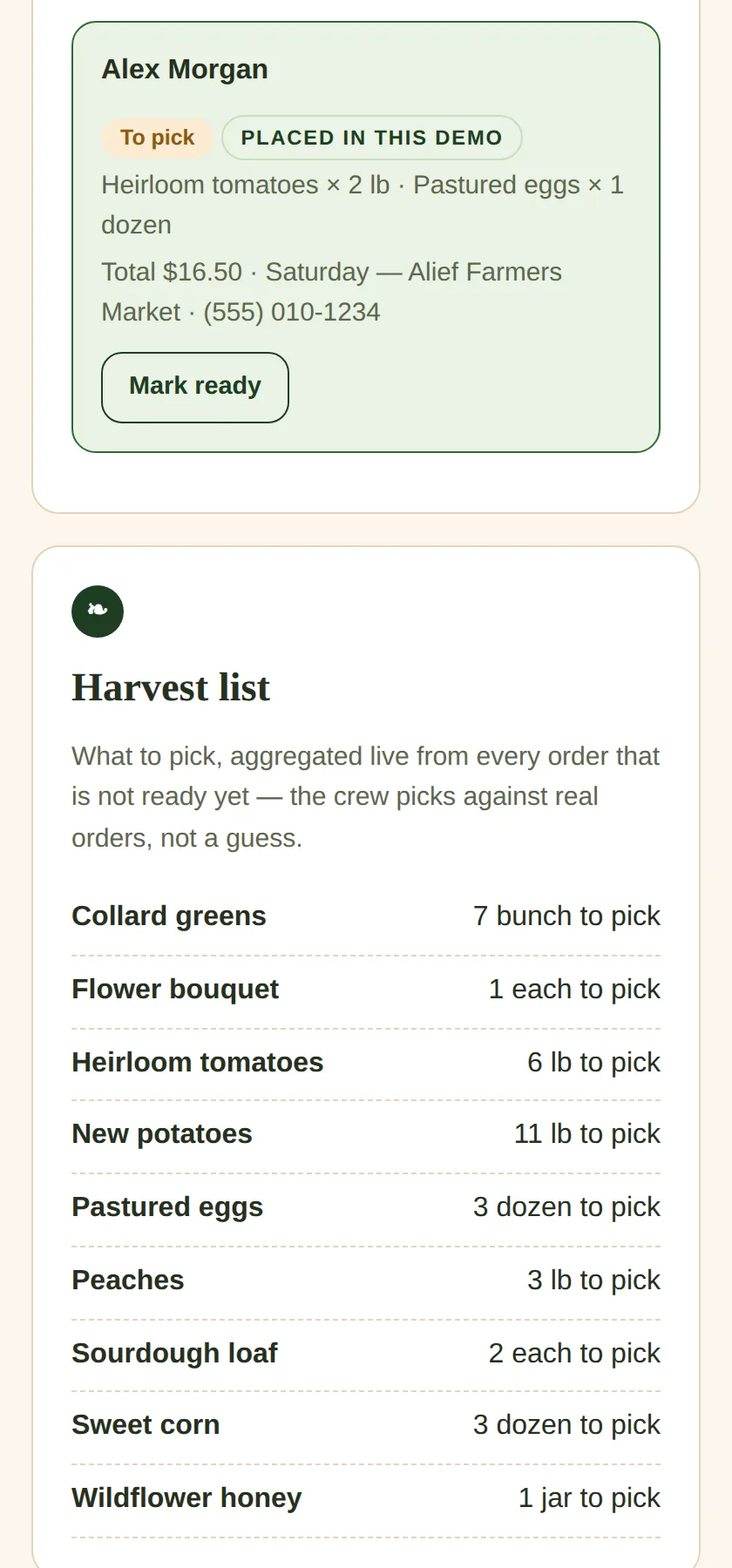
The grower picks against real orders — the harvest list is the orders, added up.
The frames are the system itself — an order placed as a customer is already on the grower's list, and the harvest list has quietly re-added itself around it.
Demo · Live
Farm & local-food business app
Three Sisters Farm (fictional). What's-growing listings with live availability, market and CSA ordering with pickup scheduling, and a grower view that turns the week's orders into a harvest list — the patterns from our own food platform, packaged for a single grower.
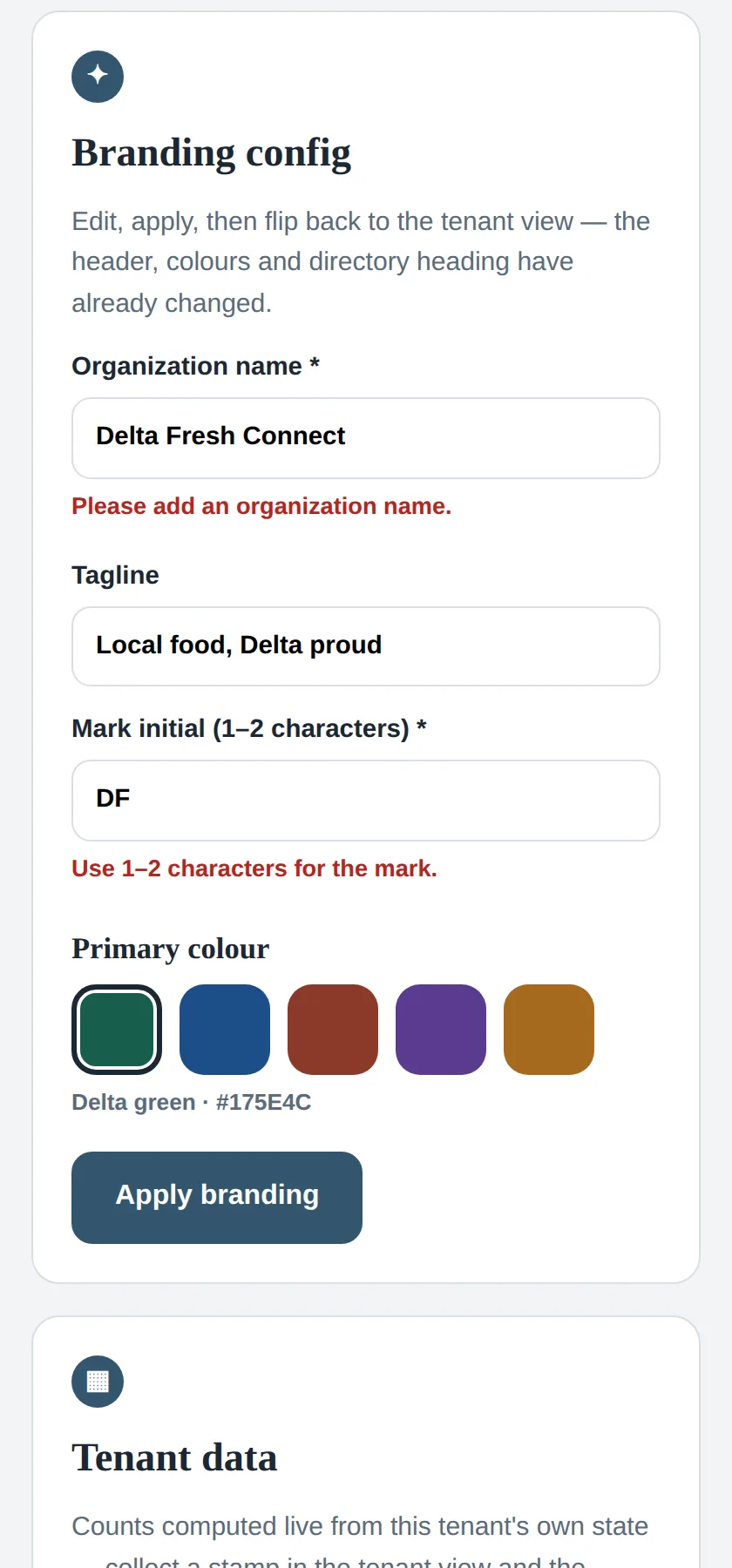
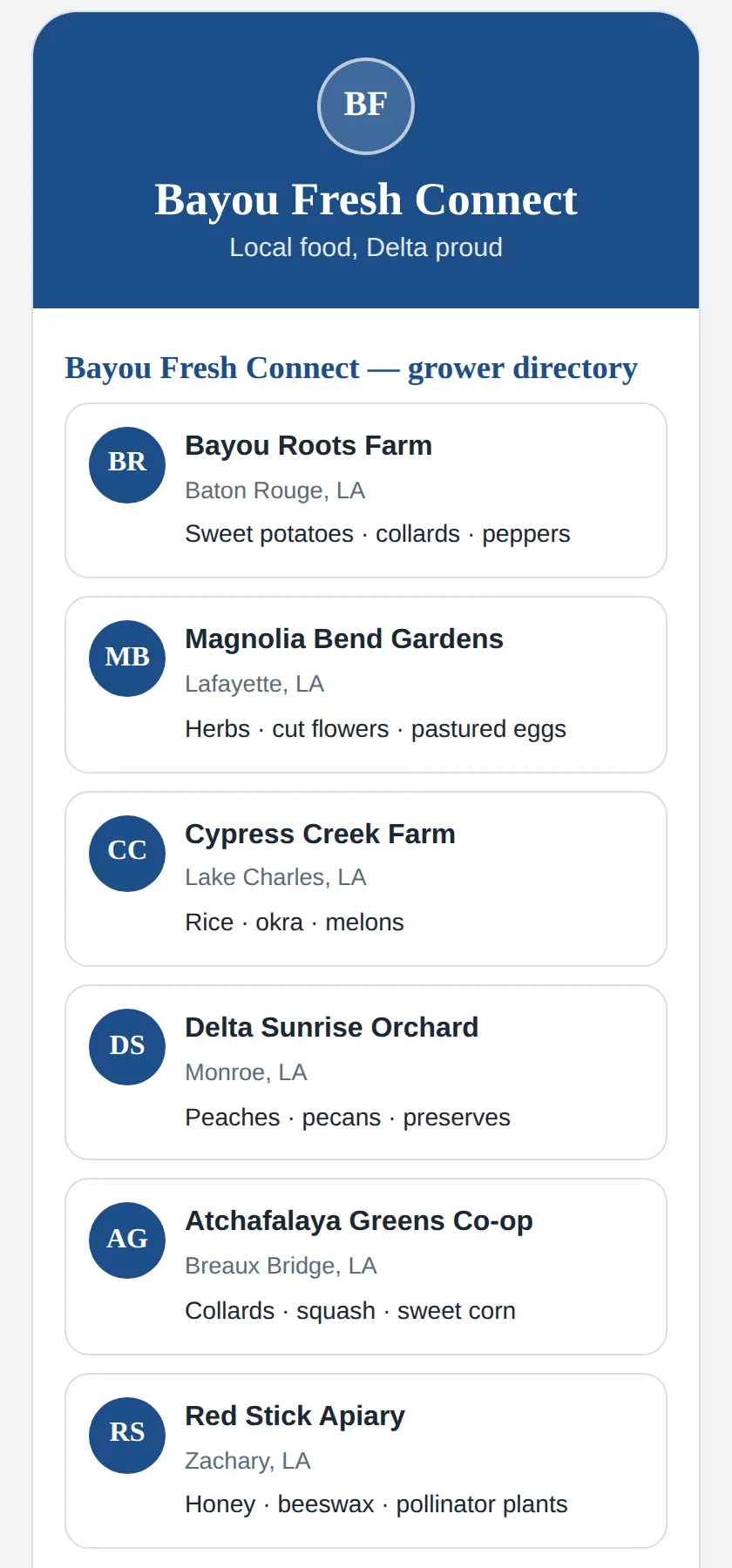
Demo tenant — Delta Fresh Connect Demo · fictional licensee
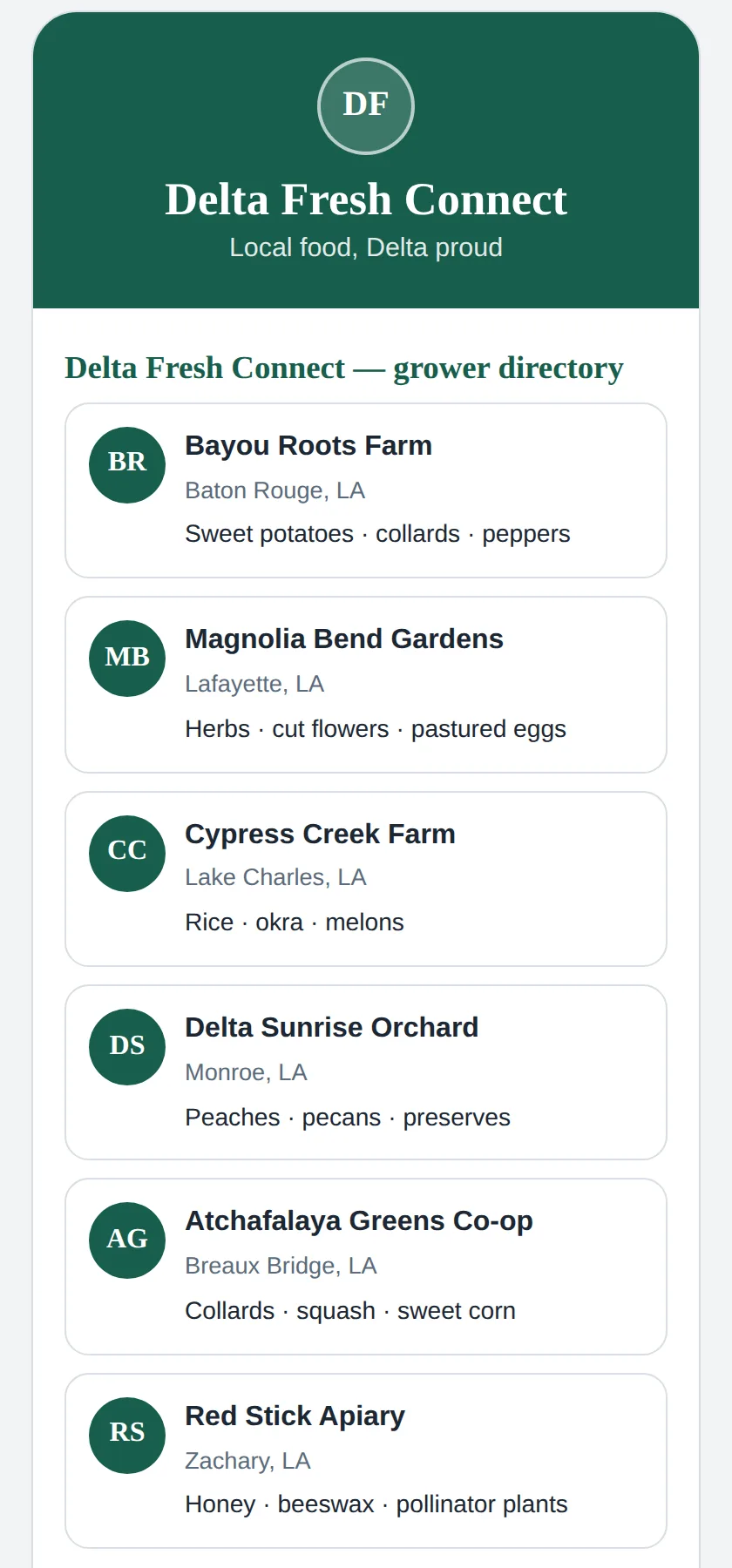
The tenant as its members see it — a licensee’s own brand, its growers, its trail.
The licensee’s admin — name, tagline, color, mark. Configuration, not code.
Re-skinned live — the same platform, another network’s name on the door.
The frames are the tenant itself, before and after its own admin changes its name and color. No developer touched it between frames — that is the demonstration.
Demo · Live
Farm2Chef licensing demo
Delta Fresh Connect (fictional licensee). The house platform's directory and trail patterns running under a licensee's brand, on a seeded, resettable demonstration tenant. Change the branding in the admin and the tenant re-skins itself — the configuration layer is the licensing product, shown honestly while it is being built.